Before feeds, followers and endless scrolling, there was Orkut.
We left scraps for friends, collected testimonials on our profiles, and joined communities built around shared interests.
Now its founder wants to rebuild that friendlier internet, and he is asking people to put their names down first.
Here is what happened, what his open letter says, how the petition works, and what the comeback attempt means.
TL;DR
- Orkut is not back yet. There is no new app to download and no launch date has been announced. What is live now is a campaign built around an open letter and a petition.
- The founder made the ask himself. On 8 October 2026, Orkut Büyükkökten posted on X and asked people to visit orkut.com and add their names if they want a more human social network to return.
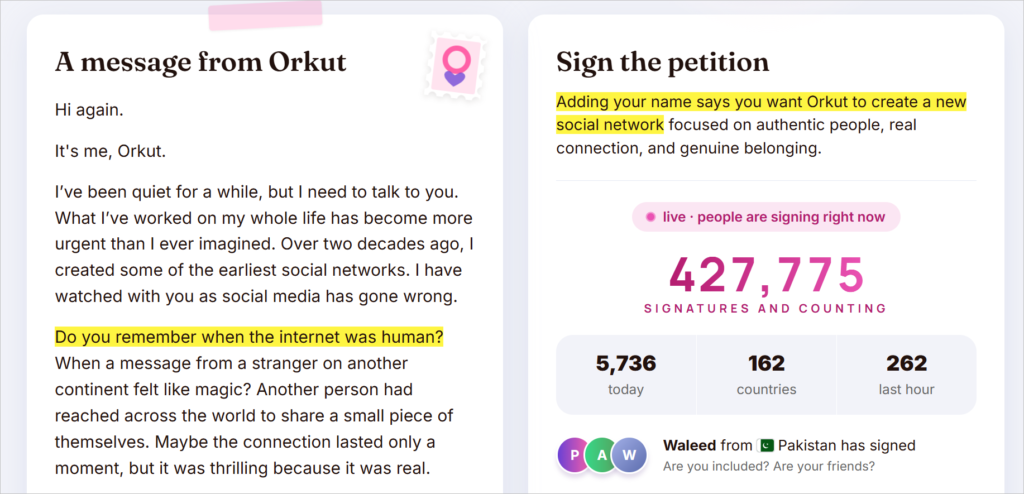
- 427,688 signatures were counted on 13 October 2026. The live counter showed signers from 162 countries, and it was still climbing when the screenshots in this article were taken.
- Signing shows support only. You share your age, name, country and email address, and you receive a supporter card to share. Signing does not reserve a username or an account.
What Orkut was, from scraps and testimonials to communities
Orkut was a social network built around profiles, scraps, testimonials and communities. It launched in January 2004 as a side project by Google engineer Orkut Büyükkökten, and it carried his first name.
Scraps and testimonials filled your profile
You made a profile and added your friends. Friends left short public messages called scraps in your scrapbook. Your closest friends wrote testimonials, short references that sat on your profile.
Communities grouped people around almost any interest
Communities grouped members around a college, a city or a favourite film star. Other communities covered repairing a particular motorcycle, riding a particular bus route or hating Mondays.
Facebook pulled users away, and Google closed Orkut in 2014
At its peak, Orkut had around 300 million users, and its largest user bases were in Brazil and India. Facebook then pulled users away with a cleaner design and better privacy controls. Google shut Orkut down in September 2014.
| When | What happened |
| Jan 2004 | Orkut launches at Google |
| At its peak | Around 300 million users |
| Sep 2014 | Google shuts Orkut down |
| 2016 to 2020 | Successor app Hello runs, then closes |
| 8 Oct 2026 | Founder asks the public to back a return |
What happened in October 2026
On Thursday, 8 October 2026, Büyükkökten posted on X and pointed readers to orkut.com. He asked people who want this kind of social network back to add their name and bring one person with them. The post offered no product demo, no launch video and no date.
What you see when you open orkut.com today
The homepage headline says you deserve better from social media. Below it sits the promise, “Social media should help us find our people.”
A personal message from the founder sits on the left of the page. The petition and its live counter sit on the right.
The counter shows more than a total. It shows how many people signed today and in the last hour, and it names a recent signer and their country.
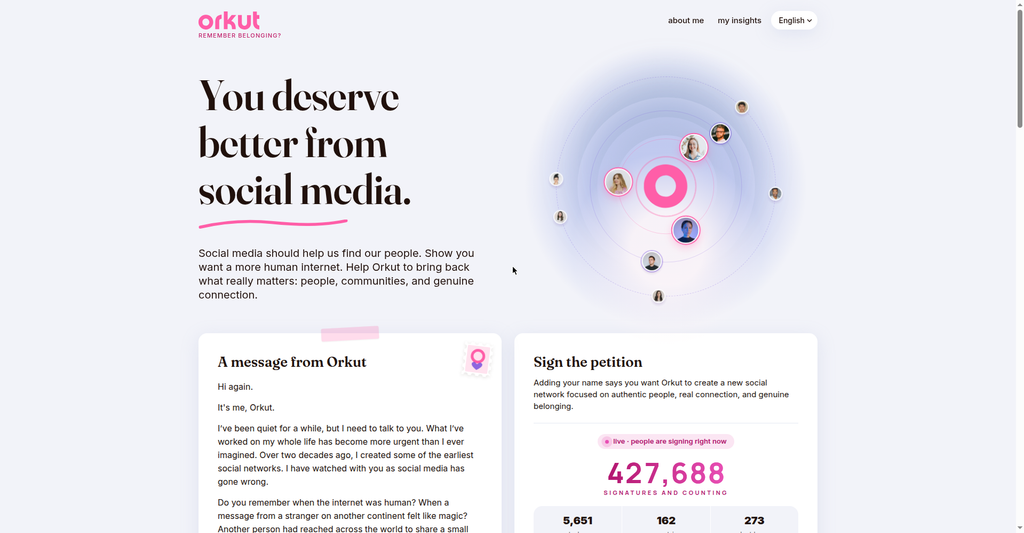
Screenshot 1 shows the orkut.com homepage on 13 October 2026, with the main headline, the founder message on the left and the live petition counter on the right at 427,688 signatures.
What the founder says in his open letter
Büyükkökten says he has been quiet for a while, and that the work he has spent his life on has become urgent. He recalls an early internet where a message from a stranger on another continent felt magical because a real person had reached out.
Feeds chased attention instead of connection
He says feeds were built to maximise engagement rather than connection. In his telling, a generation of young people was handed to algorithms designed to keep them hooked, divided and valuable to advertisers, leaving many of them lonely and anxious.
AI makes it harder to trust that a person is on the other side
He calls artificial intelligence extraordinary technology. He argues that bots, deepfakes and synthetic posts are dissolving the premise that a person is on the other side, the premise that made social networking worth building.
People miss communities, not feeds
People tell him they miss belonging to a group that shares something small and specific. As he puts it, “In a feed you’re an audience, in a community you’re a member.”
A network that rewards kindness, curiosity and trust
He imagines a network built around real people, where success is not measured by eyeballs or time spent on site. In that network, communities reward kindness, curiosity, friendship, trust and connection.
His proposed fix is one sentence long, “we rebuild the internet we first loved.” He defines that internet by real people, real connection and genuine belonging.
He asks readers to add their name to the petition. He then asks each signer to think of one person they would want there, send that person their supporter card and say why they thought of them.
You can read the letter in full on the site itself: Read the open letter and petition on orkut.com.
How the petition works and what signing actually means
Signing states that you want Orkut to create a new social network focused on real people, real connection and genuine belonging.
The form asks you to pick your age first, and the rest of the form stays locked until you do. It then asks for your name, your country and your email address.
A phone number field is marked optional, so you can leave it blank. Press the pink submit signature button and your signature is counted.
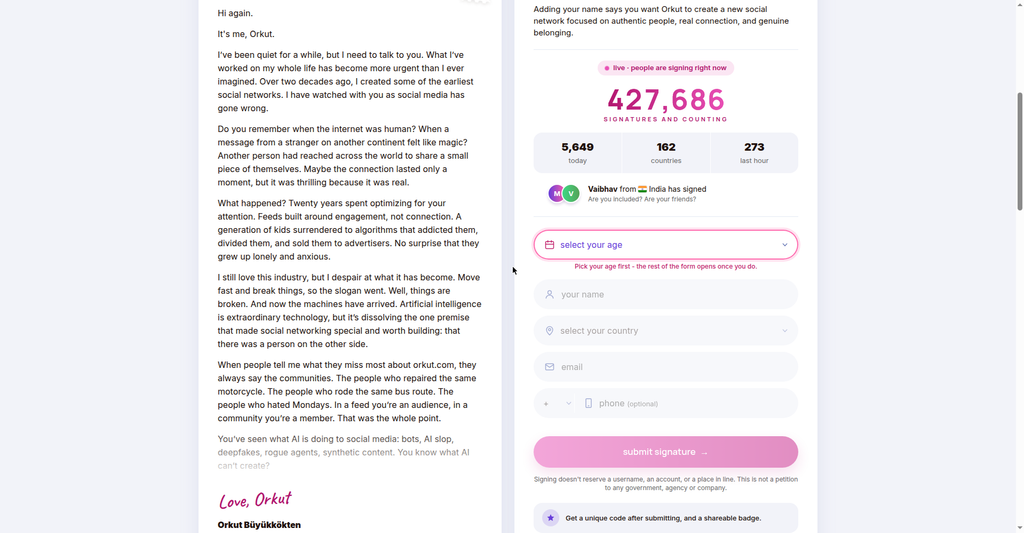
Screenshot 2 shows the petition form on orkut.com, asking for age first, then name, country and email, with phone optional and the open letter visible on the left.
What signing does not give you?
The small print under the button says signing does not reserve a username, an account or a place in line. It also says this is not a petition to any government, agency or company. You register interest, and you receive a unique supporter code and a shareable badge.
The supporter card and the country table
After you sign, the site issues a supporter card with your name, your country, your supporter code and a QR code that links back to orkut.com. The founder asks every signer to pass that card to one person and recruit the next signer.
Brazil leads the country table with 64.0% of signups
Brazil accounts for 64.0% of signups, followed by Portugal on 10.1% and Ireland on 2.6%. Paraguay, Belize, India, Uruguay, Estonia, Bahrain and Qatar complete the top ten. India, one of the two largest markets for the original Orkut, ranked sixth in this snapshot.
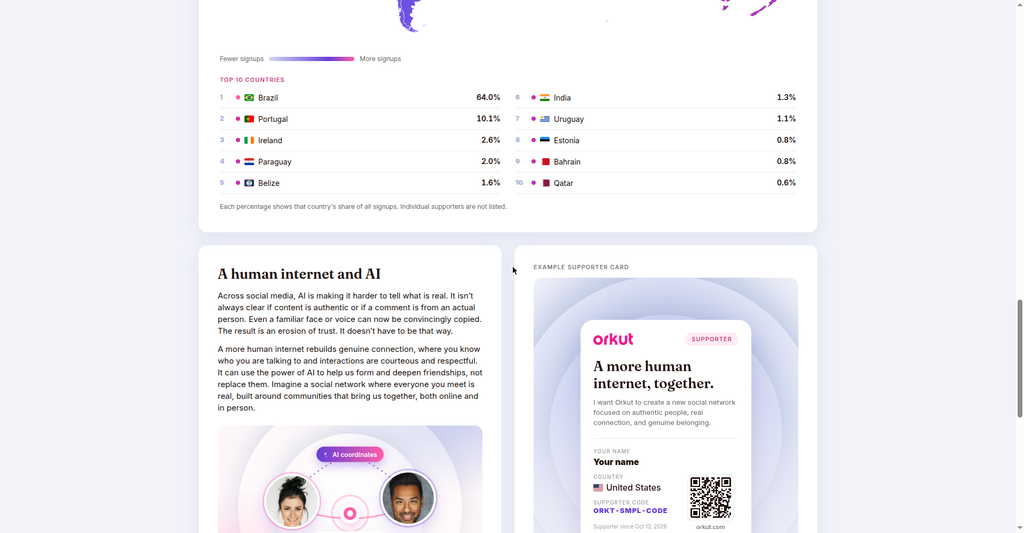
Screenshot 3 shows the example supporter card on orkut.com, with name, country, supporter code and QR code, next to the table of the top ten countries led by Brazil at 64.0% of signups.
Is Orkut actually back yet
Not yet.
There is no new Orkut you can join, no app and no launch date. The founder has not confirmed whether a new version is in development, or whether it will launch.
In 2016, Büyükkökten launched Hello, a social network built around shared interests. Hello reached more than 2 million downloads before it closed in 2020, against roughly 300 million users for Orkut at its peak.
In 2022, he teased that he was building something new. In 2024, he told WIRED he was working on a social network that would use AI and machine learning to bring people together. That platform never launched.
What this Orkut comeback attempt means
Why did a petition for a site that closed in 2014 collect 427,688 names in under a week? The letter appeals directly to memory, recalling messages from strangers on other continents and communities built around small shared interests.
Nostalgia alone does not explain the speed of the count. The letter argues that AI generated content is dissolving the premise that a person is on the other side, and that claim gives the campaign a present day problem to solve, not only a past to miss.
Büyükkökten frames his comeback around purpose rather than a product, with no app or launch date announced. That framing matches the lesson in business lessons from Careem cofounder Mudassir Sheikha on UAE Startup Story, where he describes purpose as a superpower and argues that founders should build to last rather than to exit.
Scale built on staying in touch has a recent example in this region. Botim and its journey to more than 150 million users, also on UAE Startup Story, began as a calling and messaging app and grew by helping people stay connected. Orkut is asking for the same kind of regular contact, rebuilt around communities instead of calls.
Whether Orkut becomes a network again depends on what gets built next, and no build has been announced. What is documented now is the count itself. On 13 October 2026, 427,688 people from 162 countries had given an email address to support its return.
How to add your name to the petition
- Go to orkut.com. The petition and the letter are on the homepage.
- Pick your age first. The rest of the form stays locked until you do.
- Add your name, country and email address. Phone is optional, so skip it if you prefer.
- Submit, then share your card. You will get a unique supporter code and a badge. Send the card to one person you would want in your community, and tell them why you picked them.
However, signing does not reserve your old username. No launch date has been promised.
Frequently asked questions about the Orkut comeback
What was Orkut?
Orkut was a social network launched in January 2004 at Google by engineer Orkut Büyükkökten. People used it to build a profile, leave short public messages called scraps for friends, collect written testimonials on their profiles and join communities about shared interests. It reached around 300 million users at its peak, its largest user bases were in Brazil and India, and Google shut it down in September 2014.
What is the Orkut news in October 2026?
On 8 October 2026, the founder posted on X and asked people to visit orkut.com and add their names in support of bringing Orkut back.
What does the founder say in his open letter?
He says social media lost something important when feeds began chasing attention and when AI made it harder to trust that a real person is on the other side. He says people miss communities and belonging more than they miss any feed, and he proposes rebuilding the internet we first loved, with real people, real connection and genuine belonging.
How does the petition work, and what does signing mean?
Go to orkut.com, pick your age, then add your name, country and email address, with phone optional. On submit, you are counted and you receive a unique supporter code and a shareable supporter card with a QR code. Signing does not reserve a username or an account, and it is not a petition to any government, agency or company.
Is Orkut back, and when will the new version launch?
No, Orkut is not back yet. There is no app you can join and no launch date has been announced.
The founder has not confirmed that a new version is in development. His earlier app, Hello, ran from 2016 to 2020 and reached more than 2 million downloads.
Sources and links
- Petition and open letter: orkut.com, home of the open letter, the petition and the supporter card, with screenshots taken on 13 October 2026. The counter is live, so the number will have moved since then.
A note on the numbers: signature totals, daily and hourly counts, the recent signer and the country shares are exactly as shown on orkut.com in the screenshots on 13 October 2026. Because the counter is live, all of them will have changed by the time you read this.