LuLu Hypermarket started as a single hypermarket in Abu Dhabi in 2000. Today, it has grown into one of the largest retail chains in the Middle East and beyond.
The company now operates in multiple countries and serves millions of customers through its large stores and online platform. Its growth is driven by expansion, product variety, and strong customer focus.
In this case study, we will break down how LuLu scaled from one store into a global retail brand.
TL;DR – LuLu Hypermarket Case Study
- Started in 2000 with one store in Abu Dhabi and scaled to 260+ stores across 22 countries
- Built as a one-stop retail destination combining grocery, electronics, and lifestyle products under one roof
- Growth driven by large-format stores, global sourcing, and strong customer experience
- Generates revenue through high-volume sales, private labels, and growing online channels
- Expanding through LuLu Retail with a focus on omni-channel strategy and store network growth
- Positioned as a leading retail brand in the GCC with a strong international presence
LuLu Hypermarket Highlights
| Attribute | Details |
| Company Name | LuLu Hypermarket |
| Headquarters | Abu Dhabi, UAE |
| Industry | Retail / Hypermarket |
| Founder | M.A. Yusuff Ali |
| Founded | 2000 |
| Stores | 260+ |
| Countries | 22 |
| Parent Company | LuLu Group International |
Inside LuLu: How the Retail Giant Works
What LuLu Actually Is (Beyond a Hypermarket)?
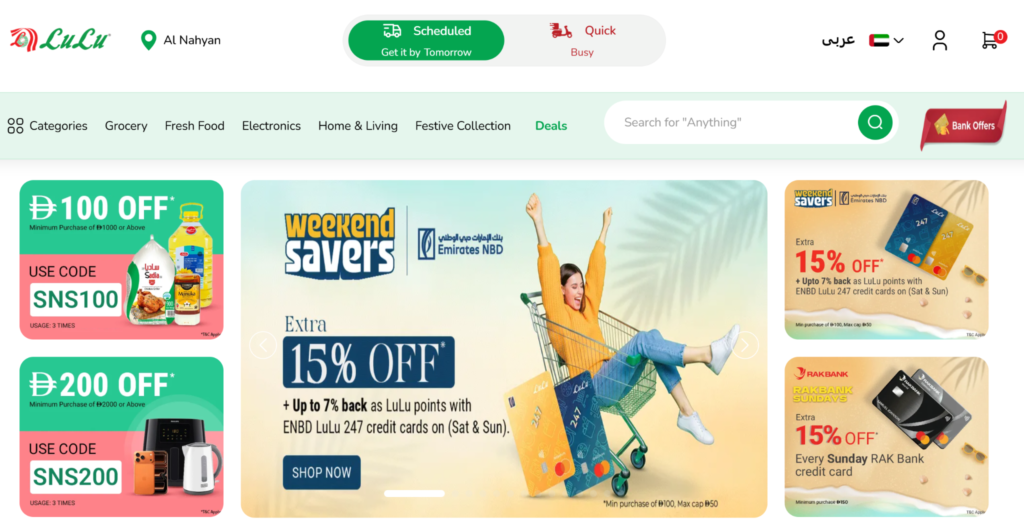
LuLu Hypermarket is the retail arm of LuLu Group. It operates large-format hypermarkets that combine multiple product categories in a single space. These stores include grocery stores, fresh food shops, electronics stores, fashion stores, home products stores, and daily essentials stores.
Each store is designed as a one-stop shopping destination. Customers can complete all their shopping in one visit instead of going to different stores. The brand focuses on variety, competitive pricing, and a modern shopping experience. It also offers additional services such as food courts, play areas, and financial service counters to enhance convenience.
The Shopping Problem LuLu Fixed
Many customers face a common problem. They need to visit different stores to buy groceries, electronics, and household items. This takes time and effort.
LuLu solves this by bringing everything into one place. Customers can shop for daily needs, bulk items, and lifestyle products under one roof. This reduces travel time and speeds up shopping.
It also solves pricing and availability issues. By sourcing products globally and buying in bulk, LuLu can offer competitive prices and a wide range of options. This helps customers easily find both local and international products.
Evolution of Lulu Hypermarket Over the Years
LuLu started as a physical retail business with large hypermarkets. Over time, it expanded its store network across multiple countries and improved store size and layout.
As customer behavior changed, LuLu added digital capabilities. It launched online shopping platforms where customers can browse products, place orders, and pay securely.
The company also introduced delivery services. Orders are delivered quickly in many regions. This helped LuLu move from a traditional retail model to an omnichannel business that combines offline and online shopping.
Today, LuLu continues to evolve by expanding its store network, improving supply chain systems, and investing in digital retail.
What is the size of the retail market in the UAE?
How Large is the UAE Retail Industry Today?
The UAE retail market is large and fast-growing. It reached about $152.7 billion in 2025 and is expected to grow to $237.7 billion by 2034. This shows steady growth with a CAGR of around 4.89%.
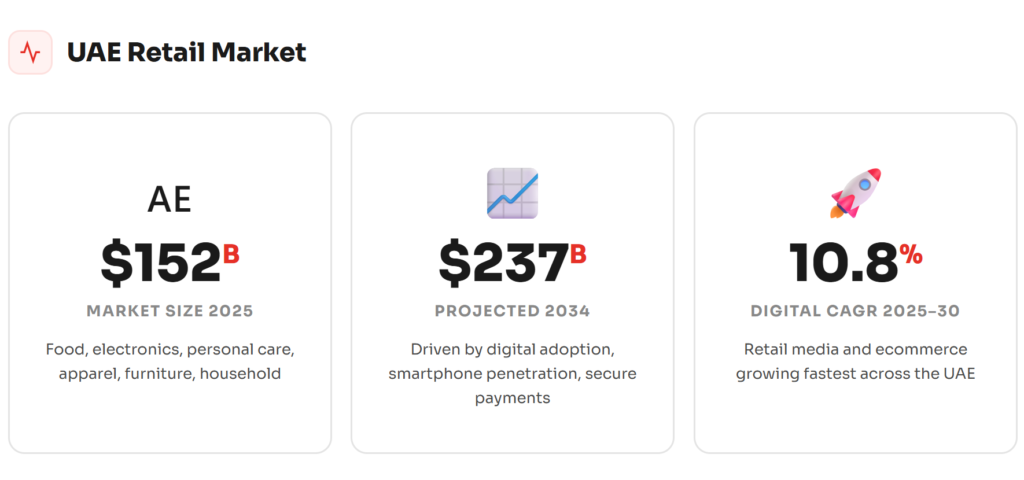
The market includes multiple categories such as food and beverages, personal care, apparel, electronics, furniture, and household products. It operates through various channels, including hypermarkets, supermarkets, specialty stores, and online platforms.
Growth trends
Retail growth in the UAE is strongly driven by digital adoption and changing customer behavior. Ecommerce continues to expand as more people prefer online shopping due to convenience, wider product selection, and faster delivery options.
Retailers are also investing heavily in digital advertising and retail media. This segment is growing rapidly, with a projected CAGR of over 10.8% from 2025 to 2030, indicating that brands are shifting budgets to online platforms.
At the same time, high internet usage, smartphone penetration, and secure payment systems are making online transactions easier. These factors are pushing traditional retailers to adopt an omni-channel model that combines physical stores with a strong online presence.
Where LuLu Fits in the Retail Landscape
LuLu Hypermarket operates strongly in the supermarket and hypermarket segments, which are among the main distribution channels in the UAE retail market.
LuLu focuses on mass-market and family shoppers. It offers a wide range of products across food, electronics, and household categories. Its strength comes from large store formats, global sourcing, and competitive pricing. This positions LuLu as a one-stop retail destination for both everyday and bulk shopping needs.
The Leadership Behind LuLu’s Expansion
M.A. Yusuff Ali
M.A. Yusuff Ali is the founder and Chairman of LuLu Group. He has played a key role in building LuLu from a single store into a global retail business.
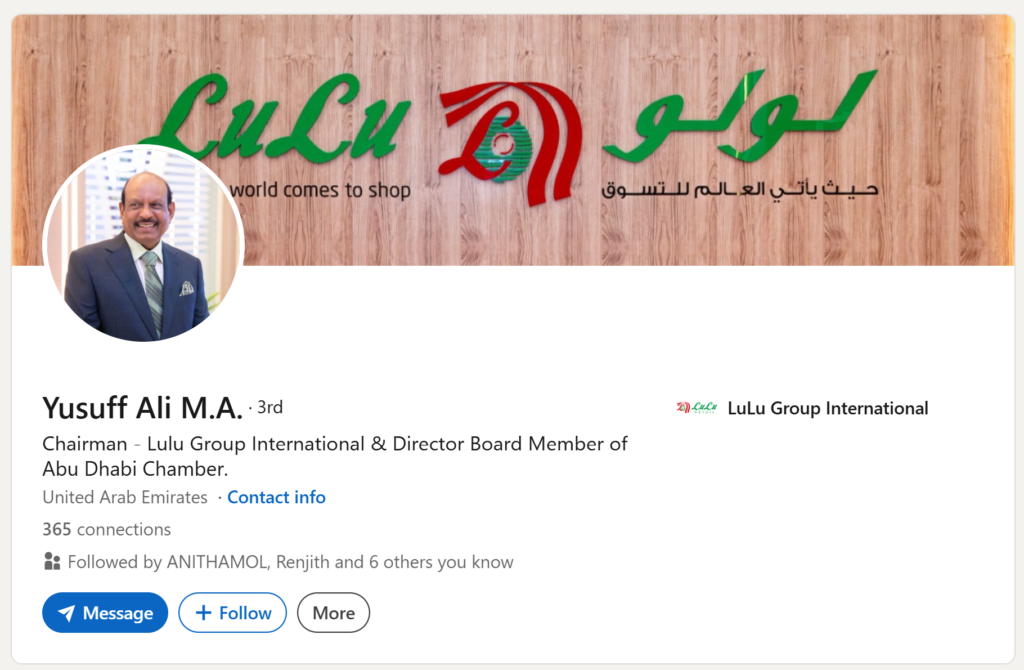
He currently serves as Chairman of LuLu Retail (since July 2024) and has led the group since its founding. He is also the Chairman and Managing Director of LuLu International Holdings Limited.
Under his leadership, LuLu expanded into multiple countries and became a multinational retail and business group. His focus has been on large-scale retail, global sourcing, and continuous expansion.
Beyond business, he holds important positions, including serving as a board member of the Abu Dhabi Chamber of Commerce and Industry. He also leads the Indian Business and Professional Group, which supports trade between India and the UAE.
He has received several major awards for his contributions. These include the Abu Dhabi Award, the Queen’s Award for trade contributions, and the Padma Shri from the Government of India. He has also been recognized as one of the most influential business leaders in the MENA region.
Saifee Rupawala
Saifee Rupawala is the Chief Executive Officer of LuLu Retail Holdings and has been serving in this role since July 2024. He is also an Executive Director and has served on the board since 2019.
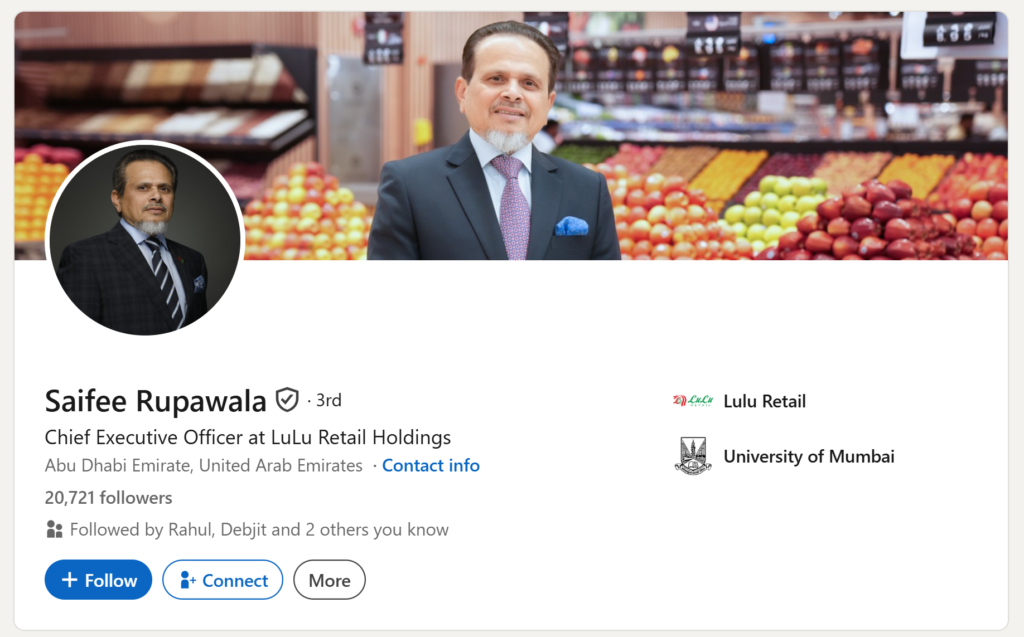
He started his career with LuLu Group in 1982. Over more than four decades, he has handled multiple leadership roles and played a key role in the company’s expansion across regions. His long experience inside the organization has helped him understand operations, supply chain, and retail strategy at scale.
As CEO, he leads the company’s growth strategy, expansion plans, and overall business operations. He focuses on scaling store networks, improving performance, and driving long-term growth.
He is also active in business and community groups. He serves as a board member of the Indian Business and Professional Group in Abu Dhabi and as a member of the steering committee of the Indian Professional Business Council in Dubai. He also contributes to social and cultural organizations.
He holds a Bachelor of Commerce degree from Mumbai University and an MBA with specialization in Financial Management and Human Resources.
Ashraf Ali M.A
Ashraf Ali M.A is the Executive Director of Global Operations at LuLu Group. He has been associated with the company since 1981 and is one of the earliest members to help build the business.
He started his journey in Abu Dhabi in a small family-owned cold storage and food trading business. Over time, he took on bigger responsibilities as the company expanded into hypermarkets and large retail formats.
He played a key role in developing store formats and improving operations across the GCC region. His work helped standardize processes and scale the business efficiently across multiple countries.
Today, he leads global retail operations for LuLu. His focus areas include improving store performance, expanding ecommerce capabilities, and growing the company’s private label products. He is known for a hands-on leadership style and strong operational control.
He also oversees daily operations across multiple countries, serving a large customer base through hundreds of stores. His leadership has helped LuLu maintain consistency while expanding globally.
He holds a Bachelor of Science degree from the University of Calicut.
The Origin Story: How LuLu Was Built
The Vision That Started LuLu
The idea behind LuLu Hypermarket was to create a modern retail experience that goes beyond traditional supermarkets. Instead of offering a limited range of products, LuLu aimed to bring all customers’ needs together in one place.
The goal was to build a one-stop shopping destination with a wide range of international and regional products. It focused on quality, variety, and convenience while delivering a better in-store experience.
The First Store That Changed Retail in Abu Dhabi
The first LuLu hypermarket was launched in Abu Dhabi. It introduced a new retail format with an ultra-modern shopping environment.
The store was designed with spacious layouts, organized product sections, and additional services such as food courts, children’s play areas, and banking facilities. This made shopping more convenient and enjoyable compared to traditional stores.
How LuLu Scaled Across 22 Countries
After early success, LuLu quickly expanded across the UAE and became a preferred shopping destination in the region. It later entered international markets, including GCC countries, Egypt, India, Indonesia, and Malaysia.
The company continued to grow by focusing on quality retailing, large store formats, and strong customer experience. Today, it operates 260+ stores and is known as a major retail brand across multiple countries.
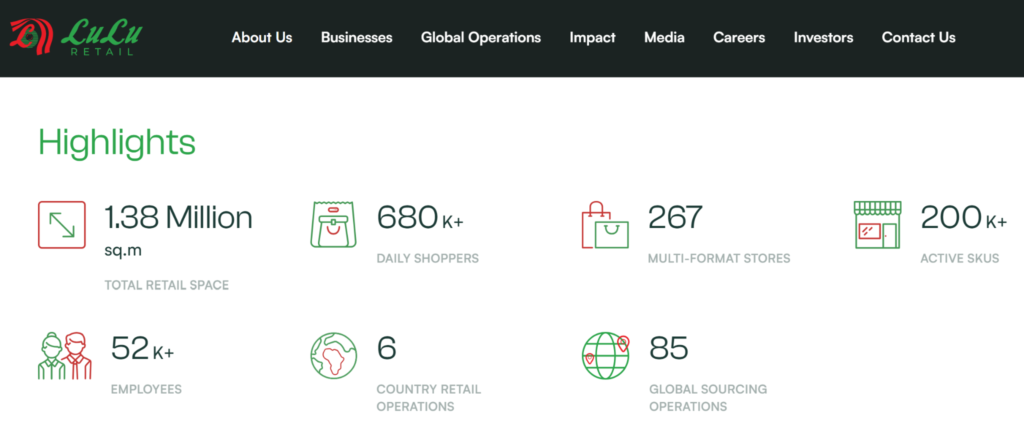
Its long-term vision is to become a global retail leader while maintaining strong values such as integrity, teamwork, innovation, and commitment.
How does LuLu Hypermarket make money?
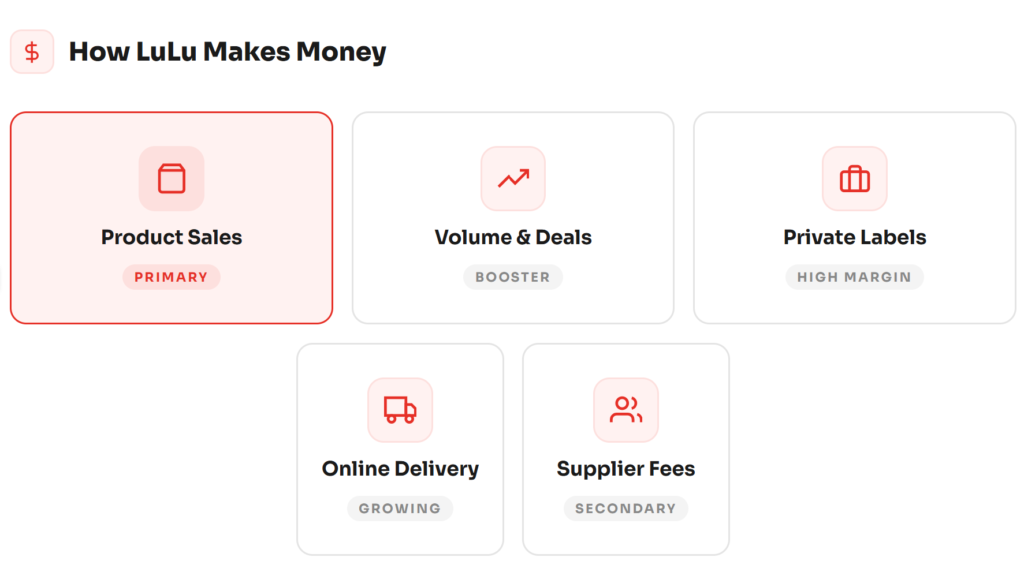
Product sales
The main source of revenue for LuLu Hypermarket comes from selling a wide range of products, including groceries, fresh food, electronics, apparel, and household items. Its large-store format allows it to stock thousands of products, attracting daily shoppers and bulk buyers, ensuring consistent, high-volume sales across all locations.
Volume strategy
LuLu uses a high-volume sales strategy by offering regular discounts, bundle deals, and promotional campaigns. These offers encourage customers to buy more items in a single visit. Seasonal sales, weekly deals, and value packs help increase average order size and foot traffic, which directly boosts total revenue across both offline and online channels.
Private labels
LuLu sells its own-brand products across multiple categories, including food, household goods, and packaged items. These private-label products usually have higher profit margins compared to third-party brands. By controlling pricing, quality, and supply, LuLu improves profitability while offering customers affordable alternatives to well-known international brands.
Online orders
LuLu is generating increasing revenue from its online shopping platform. Customers can browse products, place orders, and receive deliveries within a short time. This digital channel helps the company reach more customers beyond its physical store locations and increase sales by offering convenience, especially among busy urban consumers.
Supplier income
LuLu earns additional revenue through partnerships with brands and suppliers. Companies pay for premium shelf space, in-store promotions, and visibility across stores. These paid placements help brands increase product exposure while providing LuLu with a steady income stream beyond direct product sales.
What are the Products and Service offerings of LuLu Hypermarket?
Grocery
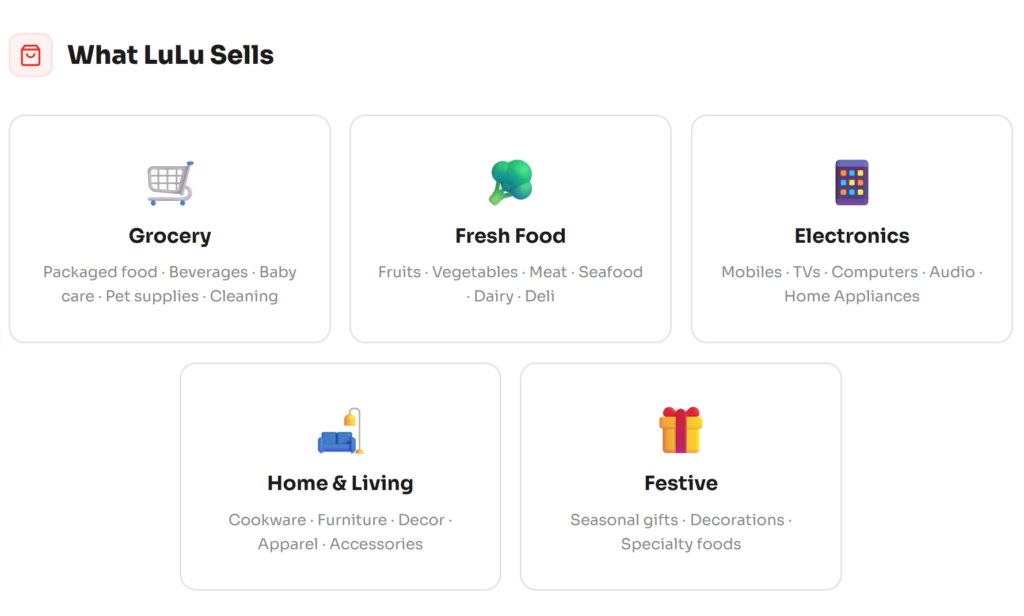
LuLu Hypermarket offers a wide range of groceries, including packaged food, snacks, beverages, rice, pulses, oils, bakery items, and daily essentials. It also covers cleaning products, baby care, health items, and pet supplies. This category supports families’ everyday shopping needs.
Fresh Food
The fresh food category includes fruits, vegetables, dairy products, eggs, meat, seafood, and frozen items. It also covers deli products, breakfast items, and ready-to-cook food. LuLu focuses on quality and freshness, offering both local and imported options.
Electronics
LuLu provides electronics such as mobile phones, televisions, computers, audio devices, and home appliances. It includes products from leading global brands and offers competitive pricing and deals, making it easy to buy electronics as part of regular shopping.
Home & Living
This category includes kitchen appliances, cookware, dining items, furniture, and home decor. It also covers apparel, accessories, and lifestyle products. It is designed to meet both daily household needs and personal lifestyle requirements.
Festive Collection
The festive collection includes seasonal and occasion-based products such as decorations, gift items, and specialty foods. It helps customers prepare for festivals and events by offering curated product selections in one place.
The Real Challenges Behind LuLu’s Scale
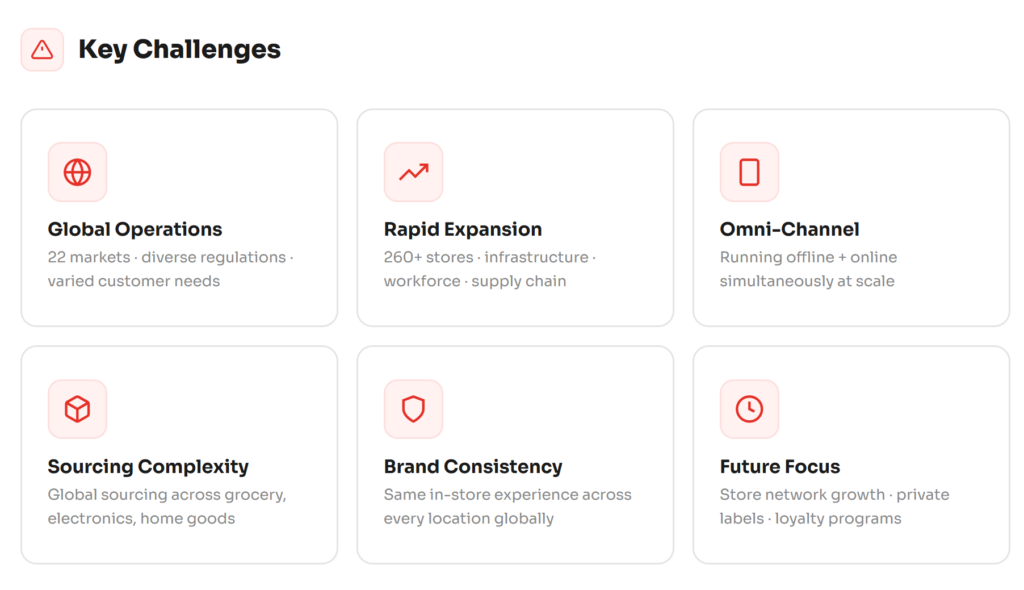
Large-scale global operations
LuLu operates across multiple countries, including the UAE, GCC, India, Egypt, Indonesia, and Malaysia. Managing such a wide geographic presence requires handling different markets, customer needs, and operational structures. Scaling operations across regions while maintaining consistency is a major challenge.
Rapid expansion and store growth
The company has expanded from a single store to 260+ locations. This level of growth requires continuous investment in infrastructure, workforce, and supply chain systems. Maintaining the same shopping experience across all stores becomes more difficult as the network grows.
Omni-channel transition
LuLu has moved from physical stores to also offering online shopping and delivery. Managing both offline and online channels requires robust systems, coordination, and continuous improvement to meet customer expectations.
Product diversity and sourcing
LuLu offers a wide range of international and regional products. Managing sourcing, inventory, and product availability across categories like grocery, electronics, and home products adds complexity to operations.
Maintaining brand experience
LuLu is known for its modern shopping environment and the multiple services offered in-store. Maintaining this experience across all locations while continuing expansion requires strong operational control and consistent execution.
LuLu vs Competitors: Retail Battle in the GCC
Carrefour
Carrefour is one of the largest global retail chains operating in the UAE and GCC. It competes directly with LuLu in the hypermarket segment. Carrefour focuses on large store formats, a wide product variety, and competitive pricing. Its strong global supply chain and brand presence make it a major competitor in both physical retail and online grocery.
Spinneys
Spinneys operates mainly in the premium supermarket segment. It targets high-income customers and focuses on quality, imported products, and store experience. Compared to LuLu, Spinneys has fewer stores but positions itself as a premium shopping destination, offering curated product offerings and higher prices.
Union Coop
Union Coop is a UAE-based retail cooperative that focuses on community-driven retail. It operates supermarkets and hypermarkets with competitive pricing and a focus on local products. It competes with LuLu in terms of grocery and daily essentials, especially among price-sensitive and local customers.
Amazon
Amazon competes with LuLu in the online retail space. It offers a wide product range, fast delivery, and a strong digital infrastructure. While LuLu is strong in physical retail, Amazon leads in ecommerce convenience, making it a key competitor in the growing online shopping segment.
| Company | Positioning | Key Strength |
| LuLu Hypermarket | Mass retail | Variety and large stores |
| Carrefour | Global hypermarket | Scale and pricing |
| Spinneys | Premium retail | High-quality products |
| Union Coop | Local retail | Community focus |
| Amazon | Ecommerce | Online convenience |
What are the future plans for LuLu Hypermarket?
LuLu Hypermarket plans to expand its store network across existing and new markets. The company is also focusing on strengthening its online platform to support omni-channel shopping.
It aims to grow its private-label products, improve the in-store experience, and increase customer engagement through loyalty programs. Overall, LuLu’s goal is to scale globally while maintaining strong retail operations and customer experience.
FAQs
When did LuLu Hypermarket start?
LuLu started in 2000 with its first hypermarket in Abu Dhabi. It began as a single large-format retail store and quickly gained popularity due to its wide product range and modern shopping experience. Over time, it expanded across the UAE and entered multiple international markets, becoming a well-known retail brand in the region.
How does LuLu Hypermarket make money?
It earns through product sales, bulk deals, private labels, and online orders. The company generates most of its revenue by selling groceries, electronics, and household items. It also increases sales through discounts and value packs. Private label products improve margins, while its online platform adds another growing revenue channel.
What is LuLu Hypermarket?
It is a large retail chain offering groceries, electronics, and lifestyle products. LuLu operates hypermarkets that combine multiple categories under one roof, making shopping convenient for customers. It focuses on product variety, quality, and pricing. The brand is known for its modern store format and strong presence across the Middle East and other regions.
How many stores does LuLu have?
It operates more than 259 stores across 22 countries. These stores are spread across the UAE, GCC countries, India, Egypt, Indonesia, and Malaysia. The large network helps LuLu serve a wide customer base and maintain a strong market presence in both regional and international retail markets.
Is LuLu expanding globally?
Yes, the company continues to expand into new markets and regions. LuLu is focused on increasing its store network and strengthening its presence in existing markets. It is also investing in online retail and supply chain improvements. This strategy supports its goal of becoming a global retail brand.