Dubai’s government school has opened registration for the fourth round of its course on the ethics of artificial intelligence, aimed at the officials who will decide how AI agents are used in public services. The Mohammed Bin Rashid School of Government will run Artificial Intelligence Ethics in the Age of Agentic AI from 23 to 26 November 2026 at its Dubai premises, in collaboration with the IEEE Standards Association. The course leads to a globally recognised certification as an AI Ethics Professional.
The timing is deliberate. The UAE government has set a framework to run agentic AI, software that carries out multi-step work with little human prompting, across 50 per cent of government sectors, services and operations within two years.
That ambition needs people who can judge whether an AI system is safe and fair before it is switched on, not after something goes wrong. This course is built to train those people.
Four days on how to judge an AI system
The programme runs in person over four days, from 8:30 in the morning to 3:30 in the afternoon, and it mixes taught sessions with case studies and interactive exercises. Participants work through real examples of generative and agentic AI in the UAE, learning how to spot risks and apply ethical frameworks to systems their own organisations might adopt. The point is practical skill, not theory: by the end, a participant should be able to assess an AI system and explain the judgement.
It is aimed at a wide group: government leaders, policymakers, governance, risk and compliance officers, and strategic planners, alongside specialists in artificial intelligence, data and digital transformation from the public and private sectors. Participants receive a completion certificate from the school, and the course qualifies them to pursue the IEEE CertifAIEd certificate as AI Ethics Professionals, subject to professional experience requirements and passing an IEEE-accredited examination taken separately.
The four tests every system must pass
The course is grounded in the IEEE CertifAIEd standard for evaluating the ethics of autonomous intelligent systems, with a tailored focus on the UAE public sector. It works through four criteria: accountability, transparency, privacy and algorithmic bias. Those four words cover most of what can go wrong with an AI system in government: nobody knowing who is responsible for a decision, nobody able to explain it, personal data leaking, or a system treating some people worse than others.
Dr Ali bin Sebaa Al Marri, Executive President of the school, says the spread of agentic AI in government work makes governance frameworks that can keep pace essential, along with public sector talent ready to use them. Building that capacity, he says, is a central pillar of the school’s mission, and the course turns understanding of technological change into opportunities to modernise public services.
Why the timing matters for Dubai’s government
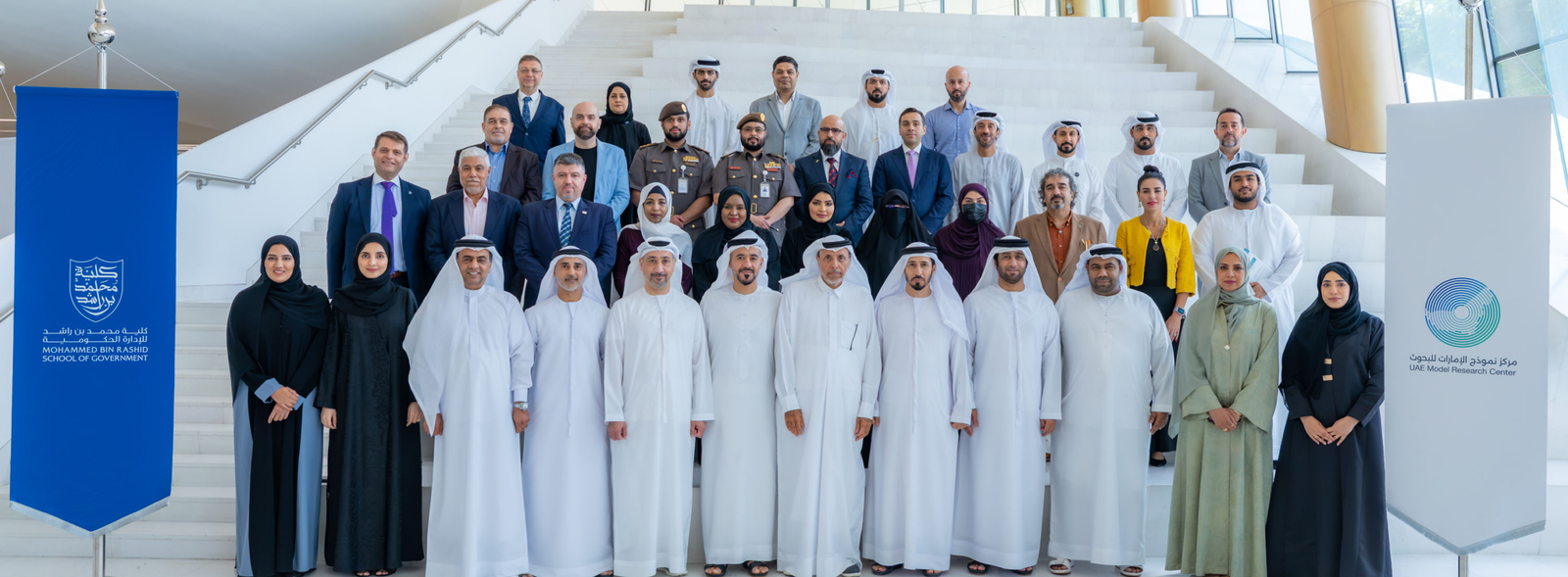
This is the fourth cohort of a programme that has been running since the first group completed it in May 2023, when 25 AI experts from 12 government and private entities took part. A further round ran in May 2025. The school signed an agreement with the IEEE Standards Association to advance AI ethics in the UAE and the region, and the course is delivered through its Centre for Future of Government with the IEEE Standards Association and the school’s Future of Governments Research Centre.
The cohort also sits inside a busy fortnight for AI governance in Dubai. As part of Dubai Future Week, the school’s Centre for Future of Government will host a workshop on 20 November 2026 on the responsible deployment and governance of agentic AI, covering the ethical challenges and what governance requires as the technology spreads. The course itself starts three days later.
What this course means for the people who will sign off on AI
Courses like this one rarely make headlines, but they matter more than most product launches. Dubai’s plan to put agentic AI across half of government in two years is bold, and bold plans need people who can say no.
An AI agent that processes permit applications or handles citizen data can save hours a day, but it can also make a biased decision at a speed no human can match. The officials in this classroom are the ones who will have to spot that before it happens.
The encouraging sign is that the course treats ethics as a skill to practise, not a box to tick. Case studies and real UAE examples beat a lecture on principles, and a certificate that requires an exam and real experience carries more weight than an attendance badge.
The question is whether enough of the right people take it. Four days is a real commitment for a busy official, and the fourth cohort suggests demand is holding. If the graduates go back and slow down one risky rollout each, the course will have done its job.