At just 19, Bashaar Naik has already explored how artificial intelligence can help solve problems in agriculture, transportation, sustainability, and digital safety.
An Indian student who grew up in Sharjah, Naik began working on AI projects during his school years. His approach has been simple. Instead of building technology for its own sake, he looks for real problems where technology can make a useful difference.
That approach has taken him from predicting soil mineral levels to estimating vehicle fuel efficiency and, most recently, developing an AI-powered browser extension designed to detect deepfake content.
His work has also earned recognition at several competitions and events, including first place at the GITEX YouthX Hackathon, first place at the RTA Dubai Sustainability and Transport Innovation Hackathon, and the Most Innovative Project award at the InnovateX Hackathon.
Growing Up in Sharjah Shaped His Approach to Innovation
Born in Mumbai in 2007, Bashaar Naik moved to the UAE when he was only three months old. He grew up in Sharjah, studied at Sharjah Indian School Juwaiza, and later joined the American University of Sharjah to study computer engineering.
Growing up in the UAE exposed Naik to people from different cultures and backgrounds. He also had access to schools, universities, competitions, exhibitions, mentorship, and opportunities to present his ideas to industry experts.
For Naik, these experiences helped shape his view of what innovation should mean.
He has said that innovation is not simply about creating something impressive or technical. Instead, he sees it as a way to address genuine challenges and improve people’s lives.
This mindset became visible in his early projects. Rather than limiting his work to classroom exercises, he used AI to explore problems connected to agriculture and transportation.
His first major AI project came in 2022, when he developed a system that could predict soil mineral concentrations. The project used information such as soil composition, temperature, pH, and rainfall to support decisions related to crop cultivation.
The project won first prize at the GITEX YouthX Hackathon, giving his early work national visibility and showing how AI could be applied to a practical problem in agriculture.
From Soil Minerals to Vehicle Fuel Efficiency
Naik’s interest in practical AI solutions did not stop with agriculture.
In 2023, he developed an AI powered vehicle fuel estimation system designed to improve vehicle fuel efficiency in the UAE.
The project connected his interest in AI with the wider goal of sustainability. Instead of focusing only on what AI could do technically, he explored how it could be used to improve the way people use resources.
His work earned first place at the RTA Dubai Sustainability and Transport Innovation Hackathon in 2023. Naik described the project as an opportunity to explore how AI could contribute to the UAE’s sustainability goals.
His work during this period also extended beyond individual AI projects.
In November 2022, one of his AI projects was selected by the Sharjah Private Education Authority for exhibition at GESS Dubai, an education exhibition and conference focused on classroom technology, products, and learning solutions.
In 2023, his contributions across academics, innovation, and community involvement were recognised with the Social Endowment Award presented by the Indian Association Sharjah.
In 2024, Naik and his school team represented the Middle East region in the international OTIS Made to Move Communities programme. Their project, EcoWheels, explored a sustainable transportation concept and secured second place internationally.
These experiences show that his interests have covered more than artificial intelligence alone. His work has brought together technology, sustainability, education, and community involvement.
Turning His Attention to the Deepfake Problem
By January 2026, Naik and his team had moved into another area where technology has created a growing challenge: deepfakes.
Deepfake technology can make digital content difficult to trust. As manipulated images, videos, and other forms of synthetic media become more advanced, identifying misleading content has become an important digital safety issue.
Naik and his team responded by developing an AI powered browser extension designed to detect deepfake content.
The tool was created as part of the InnovateX Hackathon organised by the Telecommunications and Digital Government Regulatory Authority. The project aimed to help combat online misinformation and digital fraud.
Their work received the Most Innovative Project award at the hackathon.
For Naik, the project was about more than demonstrating what AI could do. He wanted to use the technology responsibly to address a genuine problem.
This reflects the same approach seen in his earlier projects. The technology changed, but the basic question remained the same: what problem can this technology help solve?
His focus on deepfakes also represents a natural shift in his work. His earlier projects explored physical and environmental challenges, while his latest project addresses a growing problem in the digital world.
Building Opportunities Beyond Technology
Naik’s story is not limited to AI competitions and engineering projects.
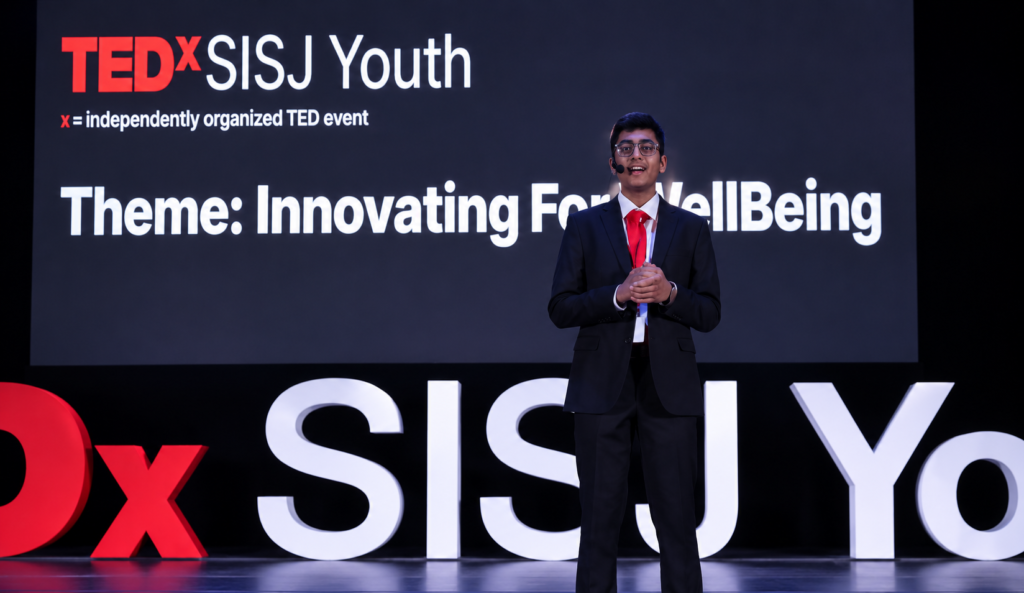
In 2024, he organised TEDxSISJ Youth, bringing together more than 30 TEDx youth speakers from across the country and different backgrounds. Later that year, he became a TEDx speaker himself and delivered a talk about the “Phygital World,” exploring the connection between physical and digital experiences.
His academic record has also been strong. He became the CBSE Grade 12 topper for his school for the 2024 to 25 batch.
These achievements add another dimension to his work. Naik has not only focused on creating technology. He has also used his opportunities to connect people, share ideas, and create platforms for other young people.
His own experience in the UAE appears to have influenced this approach. He has spoken about learning not only to benefit from opportunities but also to create opportunities for others.
Today, his interests include AI, engineering, sustainability, finance, and digital safety. His work so far suggests that he is interested in applying technology across different fields rather than limiting himself to one area.
His message to other young people is equally practical: create your own opportunities, connect with others, learn from their experiences, take initiative, and turn ideas into action.
At 19, Bashaar Naik’s journey is still at an early stage. Yet his projects already show a clear pattern. He identifies a problem, explores how technology can help, and turns the idea into a working project.
From soil minerals and fuel efficiency to deepfake detection, his work shows how young innovators can use AI for practical purposes.
The technology may continue to change, but his central idea remains consistent: innovation matters most when it helps solve real problems and creates a meaningful impact.