A presentation can take days to finish even when the main idea is already clear. Research needs to be checked, sources need to be added, data needs to be turned into charts, and every slide needs to look professional before the deck is ready to share.
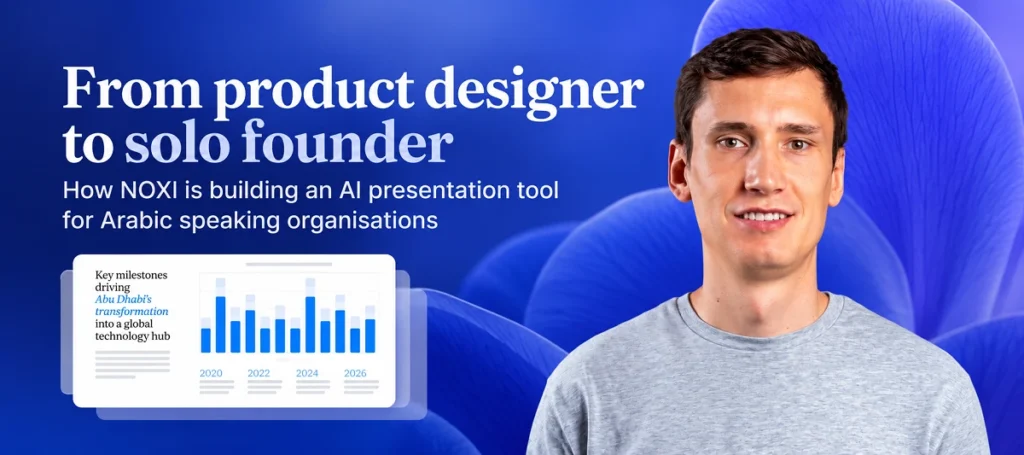
For Aidar Akmaev, founder of NOXI, this was a problem he had dealt with for years as a product designer.
That experience led him to build NOXI, an AI presentation maker from Abu Dhabi that goes beyond generating a quick set of slides.
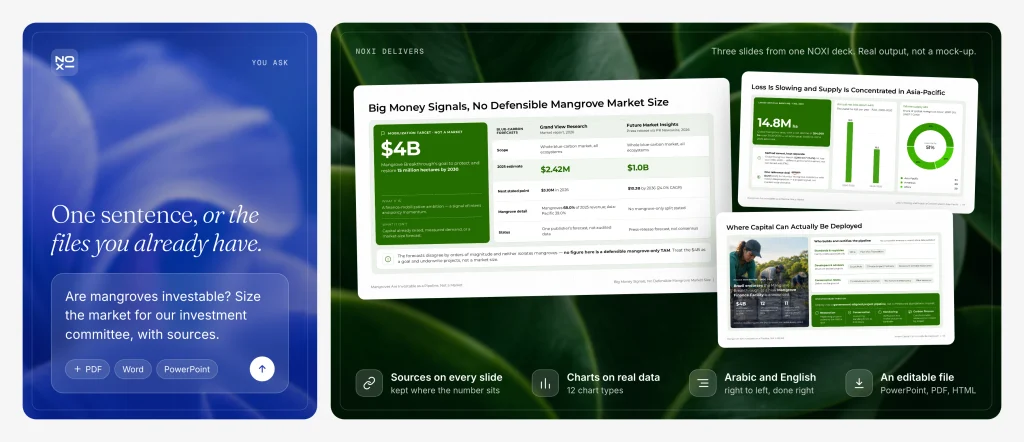
Since launching in late 2025, NOXI has grown to more than 2,000 users and 5,000 presentations without paid advertising. The platform can create presentations with sources, build charts from real data, export editable PowerPoint files, and rebuild a company’s existing presentation style from a PDF or PowerPoint file.
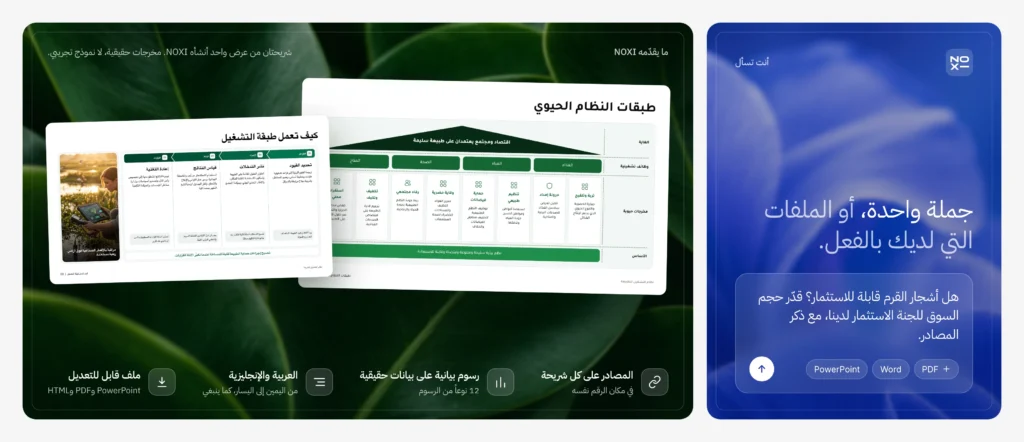
The platform also puts a strong focus on Arabic. Instead of treating Arabic as a translation feature added to an English product, NOXI has designed Arabic into the product itself.
The results are already visible in its usage. Arabic presentations accounted for less than 2% of new decks in August. Over the 30 days before 5 October, that figure reached 28%, with 332 of 1,194 new presentations created in Arabic. In the first days of October, it passed 40%.
From product design to building NOXI
The founder is a product designer and programmer with more than ten years of experience.
His career includes work on Sber’s financial super app, the MTS AI platform, and LocAI in Abu Dhabi, which was later acquired by AI71. At LocAI and AI71, he led a design team working on AI products. He now works at VentureOne, the commercialisation arm of Abu Dhabi’s Advanced Technology Research Council.
His experience with presentations played a major role in the creation of NOXI.
For years, he created decks for managers, investors, and other professional audiences. He found that the hardest part was rarely putting information onto slides.
The real work involved finding reliable research, checking the numbers, deciding how to structure the information, choosing the right visual format, and then spending hours making the slides look polished.
Even with design experience, this process could take days.
As AI models became more capable, he saw an opportunity to automate much of that work. But he did not want NOXI to become another tool that generated a first draft and left users to fix the result themselves.
The goal was to create presentations that could be used for real professional work.
Why NOXI takes a different approach to AI presentations
When the founder started building NOXI, tools such as Gamma were already popular for creating presentations quickly.
From his experience with managers and investors, however, he saw that speed was not the only problem.
Professional users often need more control over how information is presented. A strategy presentation may need a strategy house. A business report may need a scorecard. A market analysis may need a funnel or a data visualisation.
NOXI was built around the idea that slides should be designed around their content rather than forcing different types of information into the same template.
Research sources stay with the presentation. Charts can be built from real data. The platform supports analytical layouts for common business use cases, and users can continue editing the presentation after it is generated.
PowerPoint export is also a core part of the product.
Professional users often need to send a deck to a colleague, make changes before a meeting, or continue working on it inside an existing company workflow. NOXI therefore focuses on producing editable PowerPoint files instead of treating export as a final step.
The platform is free, has no watermark, and does not require users to enter a card before using it.
Building the product alone
Creating NOXI as a solo founder required work across both design and engineering.
The founder designed and developed the product himself, including the design system, interface, slide editor, backend, AI orchestration, and export systems.
NOXI uses models from Anthropic, OpenAI, and Google. Its backend runs on Supabase, while the product has its own systems for PowerPoint and PDF exports.
Development took around a year of work, often during evenings, early mornings, and weekends.
One of the biggest challenges was quality control.
An AI model can create an attractive slide but still produce problems elsewhere in the deck. Text can overflow, images can be missing, layouts can become repetitive, and numbers can differ between slides.
NOXI checks generated presentations for issues such as text overflow, empty areas, missing images, and repeated layouts. Slides that fail these checks can be rebuilt. Another process reviews the complete deck and checks numbers across slides.
PowerPoint export created another technical challenge.
The product needed to create editable files while maintaining the correct layout, fonts, and Arabic text direction. Getting those details right required building its own export system.
Growing to 2,000 users without advertising
NOXI has grown to more than 2,000 users and 5,000 presentations without paid advertising.
The founder attributes the growth to the product’s focus on practical use. When users receive a presentation that includes sources, follows their company’s visual style, contains useful charts, and remains editable in PowerPoint, they can use it without rebuilding the deck from scratch.
The usage data also shows repeat adoption. According to NOXI, 47% of creators have made two or more presentations.
Search has also become one of the platform’s main growth channels.
The founder has written more than 80 Arabic articles about creating effective presentations. These articles help users discover NOXI while also addressing questions around presentations and AI.
The platform recorded 431 sign ups in September, compared with 138 in August. Presentations created during the same period increased from 478 to 948.
Word of mouth in Abu Dhabi and among communities of managers and teachers has also contributed to the early growth.
Why Arabic has become a major part of the product
Arabic usage has increased sharply since the platform launched.
In August, fewer than 2% of new presentations were created in Arabic. Over the 30 days before 5 October, 332 of 1,194 new presentations were in Arabic, representing 28% of new decks. In the first days of October, the share passed 40%.
The product’s approach to Arabic is a key part of this growth.
NOXI was designed with Arabic from the start. This includes right to left layouts, Arabic typography, mixed Arabic and English content, and PowerPoint files that maintain the correct text direction.
Mixed language content has been one of the harder problems to solve. A presentation may contain Arabic text alongside English company names, financial figures, charts, and other English elements.
Translation alone does not solve these layout problems.
Export quality is also important for Arabic users. Incorrect text direction, fonts, or layouts can make the final PowerPoint file difficult to use.
The founder has found that Arabic users often test the exported presentation before deciding whether they can trust the product. Details such as the direction of a heading, the choice of font, and how Arabic sits next to English content can affect the quality of the final deck.
The increase in Arabic usage has made this part of NOXI’s product strategy even more important.
Building the next generation of presentations from Abu Dhabi
NOXI is now expanding beyond its initial presentation generation features.
The platform already includes team workspaces, shared decks, brand templates, and Template Studio. Template Studio can rebuild a company’s existing presentation template from a PDF or PowerPoint file.
The next goal is to make this process require less manual work.
A manager or teacher could upload a presentation they already use and let NOXI understand its visual system. Future presentations could then follow the same design without requiring the user to rebuild the style each time.
The founder is also targeting the visual quality expected in professional consulting presentations, where every slide needs to communicate clearly and look finished.
Another focus is how people will create presentations as AI becomes more capable.
NOXI recently became available through AI assistants using a connector based on the open MCP standard. Signed in users can use Claude or ChatGPT to create, edit, and export NOXI presentations.
The founder expects users to do less manual work as AI improves. Instead of clicking through presentation software and adjusting every element, users could explain what they need while AI handles more of the research, structure, design, and formatting.
The company is also working toward a sovereign edition for government organisations. A working prototype already runs without making calls to the cloud.
Abu Dhabi is central to this vision because of the region’s growing focus on AI across government and business. NOXI aims to serve Arabic speaking organisations across markets such as the UAE, Saudi Arabia, and Egypt with a presentation tool built around their language and working needs.
NOXI started with a problem its founder had experienced himself: spending days turning ideas and research into professional presentations.
Today, the product is focused on making that process faster while maintaining the design quality, editability, data accuracy, and Arabic support required for professional use.
Contact Noxi:
Note:
The details and figures in this story were confirmed by the NOXI founder during an interview with UAE Startup Story. The information about the product, growth, Arabic usage, technology, and plans comes directly from the founder and is not independently verified by UAE Startup Story.