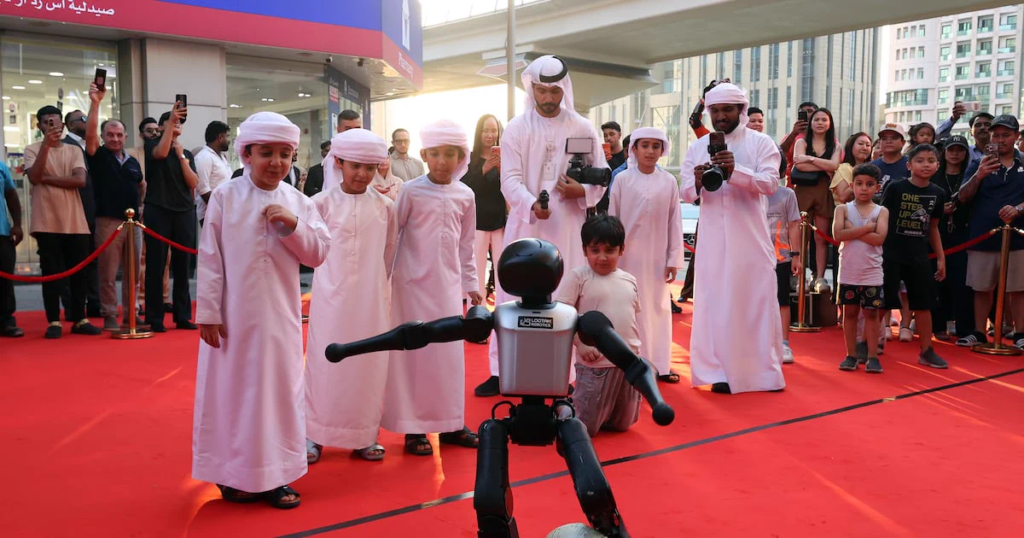
The UAE’s first dedicated humanoid robotics showroom opened its doors on Sheikh Zayed Road on Friday, and the launch looked more like a show than a shop opening. Five humanoid robots presented, danced and played football with children, while dozens of guests watched from the floor and more than 4,000 people tuned in to the livestream.
Behind the showroom is Lootah Robotics, a Dubai company that sells, rents and supports robots across the UAE. The children on the showroom floor were graduates of the company’s own robotics academy, which is a small sign of what the company is trying to do: make robots feel normal, useful and close to home.
28 robots on the floor, and more on the way
At its opening, the showroom held 28 robots. Three more were due to arrive on Saturday, with a further 16 the week after, according to founder Yousif Al Lootah. Offices and a warehouse sit above the showroom floor, stocked with additional units, and the plan is to sell to some customers and rent to others.
The range on offer goes well beyond humanoids. The company also stocks cleaning and service robots, inspection robots, and robots built for oil and gas work and for fire and safety systems in construction. It is, in effect, a shop for machines that work.
A showroom built around Dubai’s 200,000-robot goal
For Al Lootah, the opening is tied directly to a national target. “We are following the steps of our leadership,” he said at the opening. “Dubai has a vision to reach 200,000 robots by 2032, and we are a part of making that happen.”
That target sits inside the Dubai Robotics and Automation Programme, launched in 2022 by Sheikh Hamdan bin Mohammed, Crown Prince of Dubai. The programme aims to deploy 200,000 robots across the emirate by 2032 and push robotics’ share of Dubai’s GDP to 9 per cent, which would put the city among the world’s top 10 robotics and automation hubs. Al Lootah is confident the city will pass the target. “I’m telling you,” he said, “Dubai is going to have more than that many robots by then.”
Prices from a family car to a supercar
Buying a robot is not cheap, but the range is wide. “Some robots are the cost of a sports car, others a luxury car, and some an economical car,” Al Lootah said. “It depends on the kind of robot.” Purchase prices run from Dh50,000 up to Dh3 million, while rental starts below Dh5,000 and climbs into the hundreds of thousands of dirhams.
The company had already sold humanoid robots to private customers before the showroom opened. And the sale is only the start of the relationship. “When we sell the robot, it’s not just our robot,” Al Lootah said. “We need the programming, we need the operation, the maintenance for it.”
Why the timing fits a global shift
The showroom opens at a moment when humanoid robots are moving from research labs into real businesses. In the first half of 2026, humanoid robot shipments worldwide jumped 432 per cent compared with the same period a year earlier, with nearly 25,000 units shipped and revenue topping $740 million, according to International Data Corporation.
The global market, valued at $6.24 billion this year, is forecast to reach $165 billion by 2034. For the UAE specifically, analysts project growth of more than 40 per cent a year for humanoid robots through 2033, with the local market expanding from $7.4 million in 2025 to $156.8 million within seven years, according to Horizon Databook.
At AI Everything 2026, Faisal Al Bannai, adviser to the UAE President and Secretary General of the ATRC, projected that the UAE would become the largest deployer of autonomous vehicles and advanced robotics outside China within a year. The showroom on Sheikh Zayed Road is a small, visible piece of that ambition.
What the UAE’s first robot showroom means for Dubai’s streets
Al Lootah is clear that the robots are not coming for people’s jobs. “Some people are afraid that they’re going to take the jobs of the people. But I say no, it’s going to enhance the work of the people,” he said. That is the right message, but the real test will be in the details: whether a robot that cleans an office or inspects a pipeline makes the humans around it more productive, or simply makes them redundant.
What the showroom really sells is familiarity. Most people in Dubai have never stood next to a humanoid robot, let alone watched one play football with children. Once they have, the idea of robots at work stops being science fiction and starts being a procurement decision. That is the shift Dubai is betting on, and this showroom is where it begins.