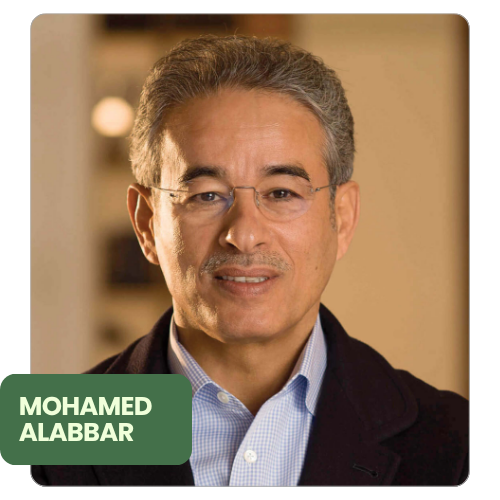
Mohamed Alabbar is a global entrepreneur and the founder of Emaar Properties and Noon, known for building large-scale businesses across real estate and ecommerce.
1. The Power of Long-Term Thinking
Mohamed Alabbar consistently argues that the greatest pitfall for modern founders is an obsession with exit culture and rapid flipping. True wealth and institutional stability are built through decades of compounding rather than a few years of frantic growth. He believes that if you are not building a brand that can survive twenty years of market fluctuations, you are not building a business but merely managing a temporary project.
For founders looking to scale, this means prioritizing the moat of your brand’s authenticity over vanity metrics.
In his discussions on AB Talks, he highlights that a long term vision allows you to make decisions that might hurt your quarterly profits but will secure your market dominance for a generation.
This philosophy requires founders to prioritize building authentic brand value and sustainable institutional stability rather than focusing on rapid, temporary gains.
Therefore, scaling requires a shift from survivalist thinking to legacy building, where every decision is vetted against its impact ten years down the line.
2. Discipline in Product Simplification
Mohamed Alabbar runs Emaar Properties with one clear rule. Keep things simple. The company sticks to four core villa types, from one to four bedrooms, and has used only two main colors for nearly 30 years.
This focus makes execution smooth. Teams follow clear systems. Decisions happen faster. Costs stay predictable. Quality remains consistent at scale. That is why places like The Dubai Mall can handle over 100 million visitors each year without operational stress.
Many founders move in the opposite direction. They keep adding products and features. This creates complexity and slows everything down. Alabbar stays disciplined. He limits choices and keeps improving the same few offerings.
💡 Key lesson: Scaling is not about doing more. It is about doing the right things better. A small set of high-value products gives you speed, efficiency, and control.
3. Strategic Caution with Equity
Alabbar’s advice to young founders is blunt and honest. He suggests you treat your equity with the same reverence you would a marriage. He often observes that entrepreneurs are too quick to trade away large chunks of their company for early-stage validation or small infusions of capital.
He warns that a fifty-fifty split made in haste today often becomes a source of resentment and legal friction tomorrow, when the company scales and the partners’ contributions inevitably diverge.
The lesson for scaling businesses is to protect your voting power and your vision. Dilution is often necessary for growth, but it must be done with extreme calculation.
He suggests that founders should exhaust all other avenues like debt, organic revenue, or sweat equity before parting with ownership.
Equity is your most expensive currency and you should spend it only when the person or entity on the other side brings a transformational value that capital alone cannot buy.
4. Resilience as a Competitive Strategy
In the face of global economic downturns, Alabbar’s stance is one of calculated calm. He views market corrections not as disasters but as cleansing periods that remove weak players and reward disciplined leaders.
He argues that a founder’s primary job during a crisis is to maintain the psychological and financial liquidity to stay in the game. This resilience is what allowed him to build Noon.com during a time when global giants seemed invincible in the region.
For founders currently scaling, resilience means building a debt-free mindset wherever possible. By maintaining a lean operation and a strong cash reserve, you turn volatility into a tool for expansion. When the market dips, resilient founders can acquire talent, land, or competitors at a discount.
Alabbar’s career proves that the winner is not necessarily the one who grows the fastest, but the one who is the most difficult to kill during a recession.
5. Leveraging the Ease of Success Environment
One of Alabbar’s most provocative lessons is that a founder’s personal intelligence is often less important than the regulatory environment they choose to inhabit.
He attributes much of his success to operating in the UAE, where the government actively facilitates growth rather than hindering it with bureaucracy. He encourages founders to be mobile and move their headquarters or operations to jurisdictions that offer the least resistance to their specific business model.
If your current environment is stifling your ability to scale through red tape or high taxes, Alabbar’s philosophy suggests you should pivot your geography. Scaling requires speed, and speed is only possible in an ecosystem designed for it.
For founders, this means performing a friction audit on your business. If the environment is the bottleneck, no amount of internal optimization will save you. Find the path of least resistance to maximize your growth potential.
6. The Arabic First Digital Sovereignty
With the creation of Noon.com, Alabbar proved that local players have a home court advantage that global giants like Amazon can never truly replicate. He focuses on digital sovereignty, which is the idea that regional businesses should own their data, their logistics, and their customer relationships. This lesson is vital for founders who feel intimidated by international competitors because your deep understanding of local culture and consumer behavior is a massive asset.
Scaling locally requires a boots-on-the-ground approach that transcends digital algorithms. Alabbar’s success with Noon came from investing in local infrastructure and tailoring the user experience to the specific nuances of the Arab world.
This means doubling down on the things that do not scale globally, like hyper-local customer service or culturally specific marketing, to build a loyal base that a global entity cannot easily disrupt with just a lower price.
7. Continuous Learning and Youth Empowerment
Despite his age, experience, and status, Alabbar remains a student CEO.
He is known for seeking advice from younger tech founders and even his own children to understand the infrastructure of the future, such as AI and blockchain. He warns that the moment a leader stops being curious is the moment their business begins to die. He believes that veterans provide the wisdom and capital, but the youth provide the energy and the foresight to identify the next big shift.
For a founder looking to scale, this means building a culture where ideas flow upward and not just downward. You must surround yourself with people who are younger and smarter than you in specific niches.
Alabbar’s ability to pivot from real estate to ecommerce and food tech is a result of his humility in the face of new information. To scale effectively, you must be willing to cannibalize your own old ideas to make room for the innovations brought by the next generation.
8. Radical Transparency in Community Growth
Alabbar’s final lesson for founders is that profit is a byproduct of solving massive social problems. He has shifted his focus from luxury to livable communities, arguing that developers must address the actual needs of the population, such as housing and food security.
He believes that the most scalable businesses are those that are integrated into the daily lives and well-being of the community. If people feel that your business makes their life better, they will protect your brand.
If you are looking for real growth, you need to move beyond a transactional relationship with your customers. As you scale, ask yourself if you are truly creating value for the society you operate in or if you are just extracting it. Alabbar teaches that long-term sustainability is only possible when your business interests are aligned with the prosperity of your customers.
As a result, a mission-driven approach provides the social capital necessary to survive scandals, competition, and shifting market trends