Startups are adopting AI faster than the overall business base
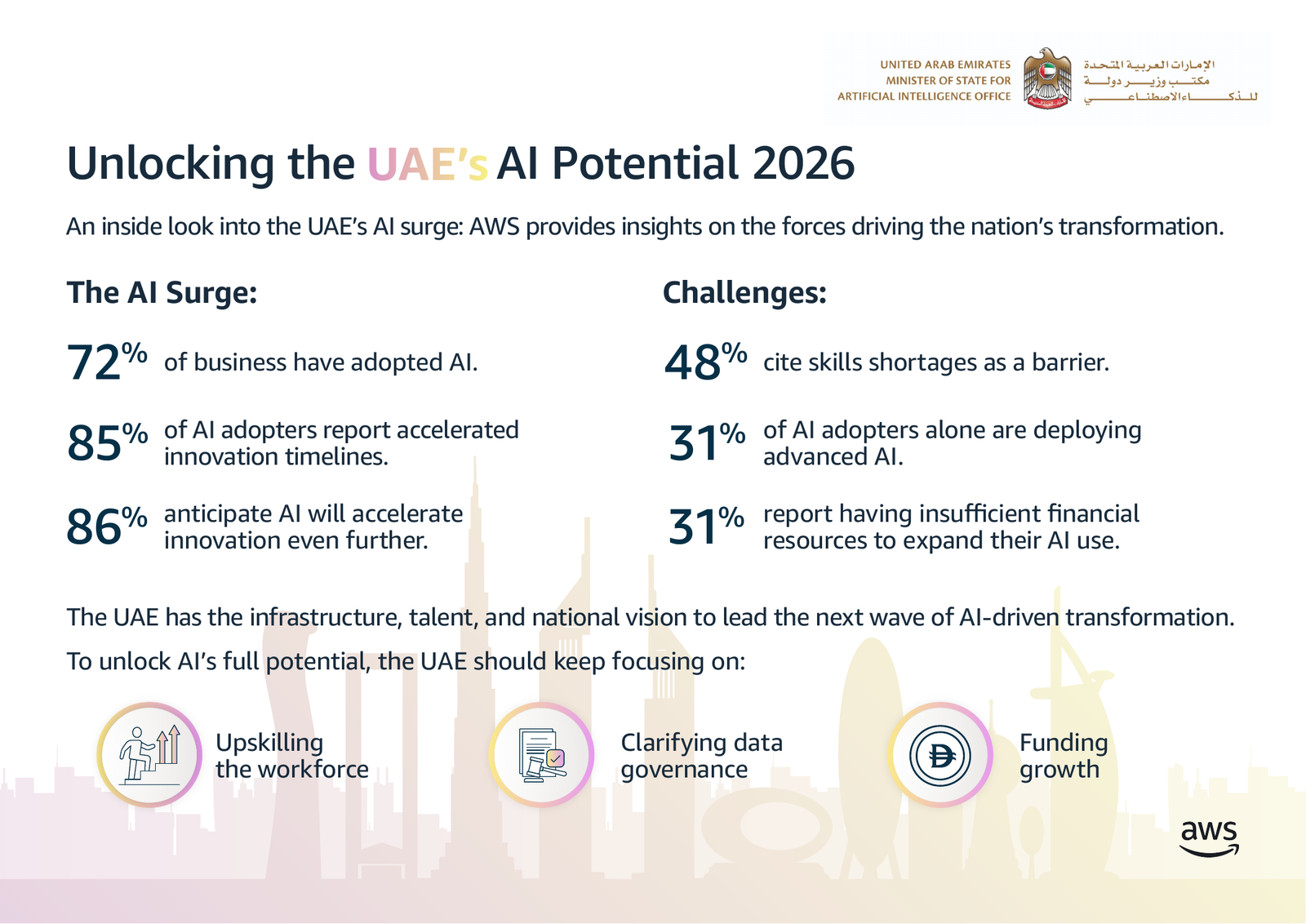
A report released on 30 September puts AI adoption among UAE startups at 88%, compared with 72% across all surveyed businesses. Among the startup adopters, 53% are using AI’s most advanced use cases, according to the report. For founders and investors, the figures offer a timely measure of how quickly AI is moving from an optional tool towards part of a product or operating model.
The Unlocking the UAE’s AI Potential 2026 report was developed by Strand Partners for Amazon Web Services (AWS), in collaboration with the UAE Artificial Intelligence Office. Its UAE research surveyed 1,000 business leaders and 1,000 members of the public, with the business sample weighted for company size, sector and region.
The published methodology does not give a separate count for startup respondents or a precise definition of a startup. The 88% figure should therefore be read as the report’s survey finding, not a census of every startup operating in the Emirates.
The report also says 42% of the startup group described their company as AI-first or as having AI at its core. It does not spell out whether that self-description means a company sells an AI product, relies on AI in its internal operations, or both.
Independent coverage by Fast Company Middle East and Gulf Business also highlighted the rise in overall adoption. AGBI’s reporting added a more cautious point: widespread use does not mean most businesses have reached the most advanced stage.
High adoption is not the same as deeper integration
The report describes advanced use as including custom AI systems, combining multiple models, or deploying agentic and autonomous tools. It says 53% of the startup adopters are using these more advanced cases, compared with 31% of AI-adopting businesses overall.
That distinction matters because installing a chatbot for routine work is not the same as changing how a company serves customers or builds a product. The more useful question for founders is whether AI is helping solve a clear customer problem, improving a process in a measurable way, or enabling a service the business could not previously offer.
The report says 85% of businesses already using AI reported faster digital change, while 86% expect AI to accelerate innovation further. Those are respondents’ assessments, not independently audited measures of productivity or revenue.
For startups, the high adoption rate is encouraging, but it does not show which teams have found repeatable customer demand or a durable advantage. A small company can experiment quickly, yet deeper integration still depends on relevant data, reliable systems, governance and people who can build and maintain them.
Skills and funding will shape what happens next
The report’s factsheet says 48% of surveyed businesses cite skills shortages as a barrier to AI adoption. It also says 31% report insufficient financial resources to expand their AI use.
For an early-stage company, those constraints can affect product priorities as well as hiring. Teams may need specialist skills, computing capacity and time to handle data responsibly, but the report does not estimate the cost of overcoming those barriers or show that every startup faces them to the same extent.
AWS has said it plans to invest up to AED 20.1 billion in its UAE cloud region through 2037. That is part of the infrastructure backdrop, not a promise that smaller companies will automatically get cheaper access or that every business can scale its AI workload. AGBI’s coverage also notes skills shortages, financial limits and legal uncertainty as obstacles to moving beyond basic use.
The next test is not simply whether UAE founders try AI. It is whether they can turn it into products customers want, retain the skills needed to deliver those products and secure the resources to grow. The report is a snapshot rather than a forecast, but its message is clear: a high adoption rate alone cannot show which businesses will build lasting value from the technology.