Talabat is a leading on-demand delivery platform in the MENA region. It connects customers with restaurants, grocery stores, pharmacies, and retailers through one app. The company started in Kuwait in 2004 and later expanded across the UAE, Qatar, Bahrain, Oman, Jordan, Iraq, and Egypt.
The company stands out for evolving from a food delivery app into a full-fledged lifestyle platform that includes quick commerce, subscriptions, and retail delivery. It also completed one of the largest tech IPOs in 2024.
In this case study, we break down how Talabat scaled, expanded, and built a strong delivery ecosystem.
Talabat in 60 Seconds: Key Insights
- Started as a simple food ordering website in Kuwait in 2004
- Expanded into 8+ countries across MENA with a localized strategy
- Built a multi-category delivery platform beyond food
- Achieved strong scale with 6M+ customers, 65K+ partners, 119K+ riders
- Raised about $2B through IPO in 2024 with high investor demand
- Growth driven by subscriptions, grocery expansion, and high order frequency
Talabat at a Glance
| Attribute | Details |
| Company Name | Talabat |
| Headquarters | Dubai, UAE |
| Industry | On-demand delivery |
| Founders | Abdulaziz Al Loughani, Khaled Al Otaibi |
| Year Founded | 2004 |
| Active Customers | 6M+ |
| Active Partners | 65,000+ |
| Active Riders | 119,000+ |
| Parent Company | Delivery Hero |
| IPO | Dubai Financial Market (2024) |
What is Talabat? Inside Its Business Model and Growth
Founding story and current status
Talabat started in 2004 in Kuwait as a simple website that let users order food online rather than calling restaurants. The founders saw a gap in convenience and used technology to simplify the process.
The platform gained early traction because it made ordering faster and more reliable. As internet and smartphone usage increased, Talabat expanded into mobile apps and entered new markets across the Middle East.
Today, Talabat operates in multiple MENA countries and has evolved into a large on-demand delivery platform. It connects millions of customers with thousands of partners and riders, making it one of the region’s leading delivery ecosystems.
What Problem Did Talabat Solve in the Market?
Before Talabat, ordering food was slow and inefficient. Customers had to search for restaurant numbers, wait on calls, and often faced order errors. Restaurants also struggled to reach online customers and manage delivery efficiently.
Talabat solves these problems by offering a single platform where users can browse menus, place orders, and track deliveries in real time. It reduces friction in the ordering process and improves accuracy.
For businesses, it provides access to a large customer base, delivery infrastructure, and tools to manage orders and improve sales.
How Talabat Evolved from Food App to Everyday Platform
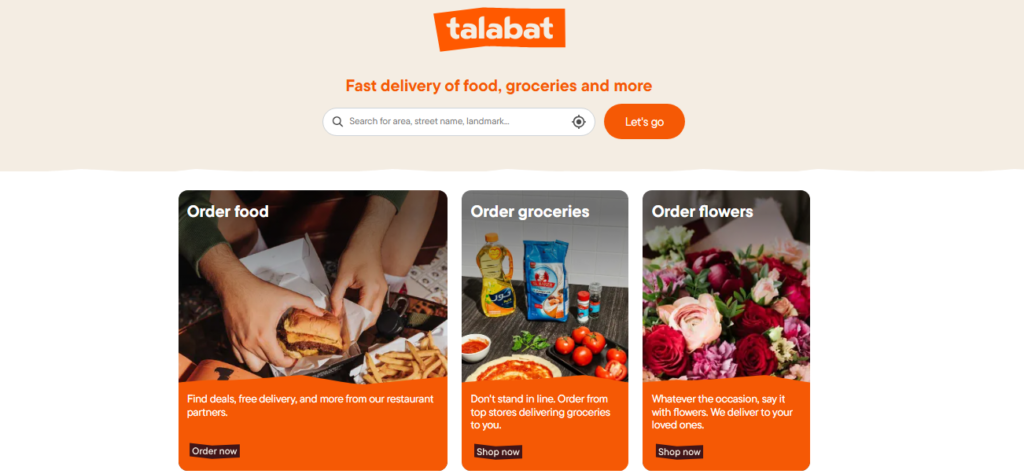
Talabat started as a food delivery platform and still offers a wide range of restaurant options as its core service. It later expanded into grocery and retail through tMart, enabling fast delivery of daily essentials. The company introduced Talabat Pro, a subscription model that offers free delivery and exclusive deals to boost repeat usage. It also launched dine-out features with in-app discounts at restaurants. Over time, Talabat added categories such as flowers, medicine, and convenience items, transforming the platform into a daily-use app and increasing overall order frequency and customer retention.
What is the size of the food delivery market in the UAE?
Market Size
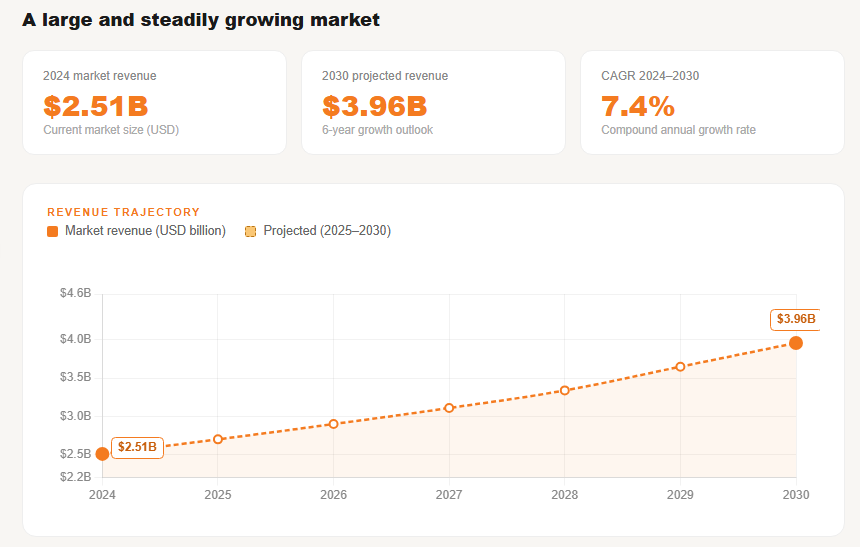
The UAE online food delivery market is large and steadily growing. In 2024, the market generated approximately $2.51 billion in revenue and is expected to reach nearly $3.96 billion by 2030, growing at a 7.4% CAGR.
Talabat operates within this high-value market while also expanding across the broader MENA region. The platform connects users across 8 countries, covering a population of over 185 million and a large digital user base.
Growth Trends
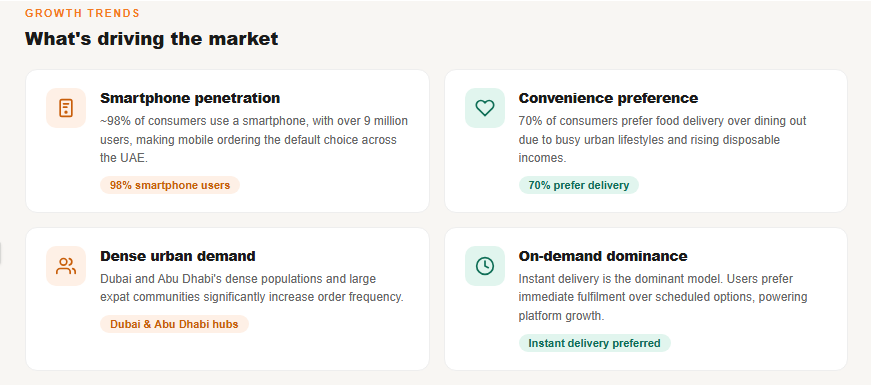
Growth in the UAE food delivery market is driven by strong digital adoption and changing consumer behavior. Smartphone penetration is extremely high, with around 98% of consumers using a smartphone and over 9 million users, making mobile ordering the default choice.
Convenience is the biggest driver. Around 70% of consumers prefer food delivery over traditional dining due to busy urban lifestyles and higher disposable income. This demand is especially strong in cities like Dubai and Abu Dhabi, where dense populations and a large expat base increase order frequency.
The market is also expanding due to a growing number of restaurant partnerships, with thousands of outlets joining platforms to reach more customers. At the same time, on-demand delivery remains the dominant model, as users prefer instant service over scheduled options.
Overall, the shift toward convenience, mobile usage, and instant delivery continues to drive steady market growth.
Where Does Talabat Stand in This Market?
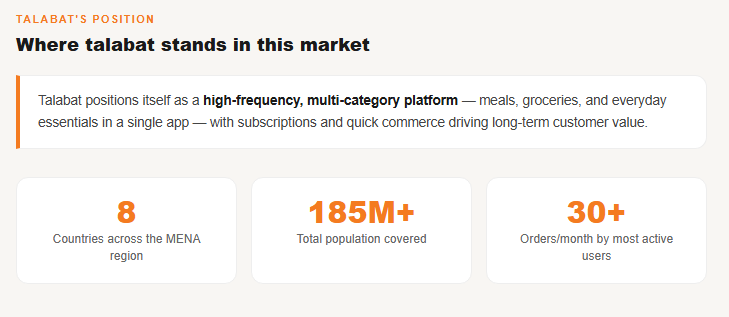
Talabat positions itself as a high-frequency, multi-category platform designed for everyday use. Instead of focusing solely on food delivery, it aims to become a single app for multiple needs, such as meals, groceries, and essentials.
This strategy is reflected in user behavior. A large share of customers use more than one category, and the most engaged users place over 30 orders per month.
Talabat also strengthens retention through services like subscriptions and quick commerce, which increase repeat usage. This positioning helps the company move beyond one-time transactions and build long-term customer value in a competitive market.
Who are the founders and core team members of Talabat?
Abdulaziz Al Loughani
Abdulaziz Al Loughani is a co-founder of Talabat and an experienced entrepreneur and investor in the MENA region. He served as CEO of Talabat until 2010, where he helped build the platform from an early stage into a leading food delivery service.

After Talabat, he focused on venture building and investments. He is the Chairman and CEO of Floward, an e-commerce platform for flowers and gifts, and a Managing Partner at Faith Capital, which invests in startups across the region.
He also played a key public sector role as the founding Executive Vice Chairman of the Kuwait National Fund for SMEs, a $7 billion initiative aimed at supporting entrepreneurship.
Abdulaziz holds a degree in Information Systems and E-Commerce from the University of Toledo and an MBA from London Business School.
Khaled Al Otaibi
Khaled Al Otaibi is a co-founder of Talabat and played a key role in building the platform during its early stages. He helped launch Talabat in Kuwait in 2004, focusing on creating a simple and reliable online food-ordering experience. The platform quickly gained traction by offering convenience and a wide range of restaurant options.
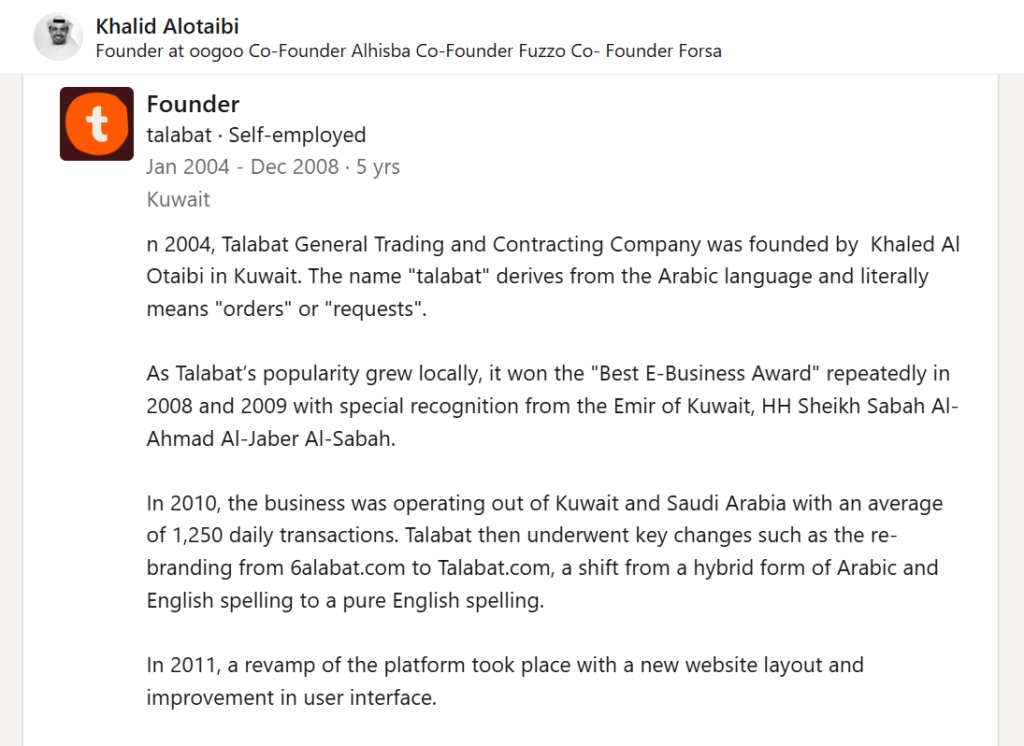
As Talabat grew, the company expanded into new markets and introduced mobile apps to meet increasing demand, becoming a leading delivery platform in the region.
After Talabat, Khaled continued his entrepreneurial journey by founding and co-founding multiple ventures across technology and real estate, including Floward, Alhisba, and Forsa. He has also led companies like CLEAR and Trend Integrated Solutions, focusing on building digital products and services.
Toon Gyssels
Toon Gyssels is the CEO of Talabat and leads its current growth strategy. He took over the role in 2025 after previously serving as COO for Talabat under Delivery Hero, where he managed operations across multiple MENA markets and helped scale the business.
He has also worked with companies like Kitopi and Moove, focusing on operations and scaling. His current focus is on expanding Talabat into a multi-category, everyday use platform through quick commerce, subscriptions, and new services.
Jérémy Doutté
Jérémy Doutté is the Chief Operating Officer of Talabat and leads its business operations and execution across markets. He joined the company in 2020 and has held multiple leadership roles, including VP UAE and Chief Business Officer, before becoming COO in 2026.

Before Talabat, he spent several years at Jumia, where he led operations across multiple countries and played a key role in the company’s initial public offering on the NYSE. He also worked at McKinsey and UBS earlier in his career.
His focus at Talabat is on scaling operations, improving performance, and building a strong execution engine across the region.
How Talabat Started: The Story Behind Its Growth
The Idea That Started It All
Talabat started in 2004 in Kuwait as a simple website where users could browse restaurant menus and place orders online. At that time, most people relied on phone calls to order food, a process that was slow and error-prone. The founders identified this gap and built a digital solution that made ordering faster, easier, and more organized for both customers and restaurants.
Early Challenges and Market Barriers
In the early years, internet usage in the region was still developing, and many users were hesitant to trust online platforms. Talabat had to build confidence in online ordering, ensure reliable delivery, and convince restaurants to join the platform. Managing logistics and maintaining consistent service quality were also key challenges during this phase.
How Talabat Gained Its First Traction
Talabat gained traction by offering convenience, variety, and a better user experience. As more users adopted online ordering, the platform grew quickly in Kuwait. This success helped Talabat expand into other GCC markets with similar demand, turning it into a regional delivery platform.
What is the meaning behind Talabat’s name, tagline, and logo?
Meaning behind the name
The name “Talabat” comes from Arabic and means “orders” or “requests.” It directly reflects the platform’s core purpose of helping users place orders easily. The name is simple, functional, and aligned with everyday usage across MENA markets.
Tagline and messaging evolution
Talabat’s messaging has evolved from food delivery to a broader everyday platform. Phrases like “fast delivery of food, groceries, and more” and “get what you need, when you need it” show a clear shift toward convenience, speed, and multi-category usage rather than just restaurant ordering.
Logo design and changes
Talabat’s logo has evolved in four clear stages, each reflecting its growth:

- 2004–2012: “talabat.com” with a handwritten style, showing an early internet startup phase
- 2012–2017: Simplified “Talabat” with a more readable, brand-focused identity
- 2017–2020: Cleaner and bolder typography, improving brand consistency
- 2020–present: Fully minimal lowercase “talabat” logo, designed for digital platforms and strong recall
Instead of focusing on decoration, each change improves clarity, usability, and recognition across platforms. This aligns with Talabat’s shift toward a high-frequency, app-first delivery service used daily.
How Talabat Makes Money: Business Model Breakdown
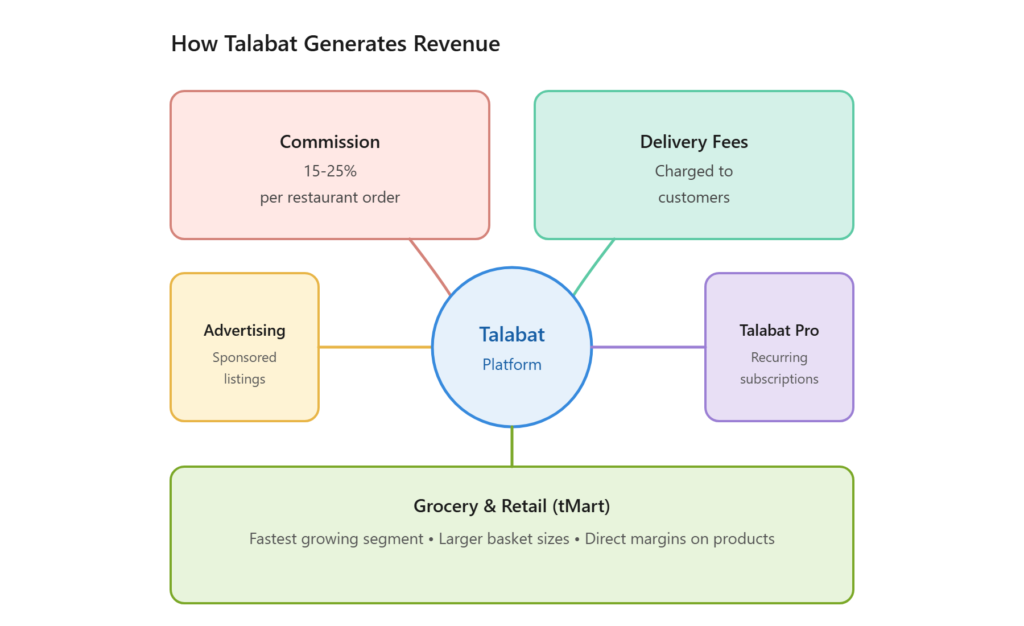
Talabat follows a hyperlocal on-demand delivery model. It connects customers, partners, and riders on one platform and earns revenue through multiple streams built around transactions, visibility, and repeat usage.
Commission from partners
Talabat earns most of its revenue by charging restaurants a commission on each order, usually between 15 and 25 percent. This fee varies based on location, demand, and service level. It gives restaurants access to a large customer base, while Talabat benefits from every transaction processed on the platform.
Delivery fees
Customers pay delivery charges depending on distance, time, and order conditions. These fees are a direct revenue source and also help cover logistics costs. Talabat sometimes reduces or waives delivery fees during promotions to increase order volume, attract new users, and encourage higher per-order spending.
Advertising revenue
Talabat generates revenue through in-app advertising and sponsored listings. Restaurants pay to appear at the top of search results or featured sections, increasing their visibility. This helps partners drive more orders while allowing Talabat to monetize its platform traffic without directly impacting customer pricing.
Subscription revenue (talabat pro)
Talabat offers a subscription service called Talabat Pro that provides benefits like free delivery and exclusive discounts. This model creates recurring revenue and improves customer retention. Subscribers tend to order more frequently, thereby increasing lifetime value and strengthening long-term engagement on the platform.
Grocery and retail margins
Through tMart and retail partnerships, Talabat earns margins on grocery and convenience orders. These orders often have larger basket sizes than food delivery orders. This category helps diversify revenue streams and positions Talabat beyond food into everyday essential deliveries, increasing overall platform usage.
High-frequency usage model
Talabat focuses on driving repeat usage rather than one-time transactions. Its most active users place more than 30 orders per month across categories. This high-frequency behavior improves unit economics, increases revenue per user, and helps the platform maintain strong engagement and long-term customer loyalty.
Funding Journey and IPO Milestone
Talabat’s growth has been supported by strategic acquisitions and strong investor backing rather than frequent early-stage funding rounds. The company was acquired in 2015 by Rocket Internet’s Global Online Takeaway Group for about $170 million, a move that helped it scale across the region and strengthen its operations.
It later became part of Delivery Hero, one of the world’s largest food delivery companies. This gave Talabat access to global technology, capital, and operational expertise.
A major milestone came in 2024 when Talabat completed its initial public offering on the Dubai Financial Market. The company raised around $2 billion, making it one of the largest global tech IPOs of the year. Strong investor demand led to the offering being priced at the top of its range, highlighting confidence in its growth and market position.
Talabat Growth Metrics: Users, Revenue, and Scale
- Talabat has built a large-scale user base with over 6 million active customers across its markets. This reflects strong adoption and frequent usage, making it one of the most used delivery platforms in the MENA region.
- The platform works with more than 65,000 partners, including restaurants and retailers. This wide network helps offer variety to users and strengthens its competitive position in each market.
- Talabat operates with a delivery network of over 119,000 riders, enabling fast and reliable order fulfillment across multiple cities and countries.
- The company reported around $2.5 billion in gross merchandise value in a single quarter, showing strong transaction volume and consistent demand growth.
- Revenue reached approximately $1 billion in a quarter, supported by commissions, delivery fees, subscriptions, and retail expansion.
- Grocery and retail segments are growing faster than food delivery and now account for a significant share of total GMV, indicating successful category expansion.
- Subscription users play a key role in growth, with Talabat Pro contributing a large share of total orders and improving customer retention.
- High-frequency usage is a major driver, with top users placing more than 30 orders per month, thereby increasing customer lifetime value and platform efficiency.
Key Partnerships Driving Talabat’s Growth
Bolt partnership (mobility integration)
Talabat partnered with Bolt to expand beyond delivery into mobility. Talabat Pro users get discounts on Bolt rides, adding more value to the subscription. This move helps Talabat become part of daily routines, not just ordering, by combining food, grocery, and transport in one ecosystem.
EVO partnership (electric delivery initiative)
Talabat partnered with EVO to launch electric bike delivery pilots in Oman. This initiative focuses on reducing emissions and improving sustainability in last-mile logistics. It also helps lower delivery costs over time while aligning with regional sustainability goals.
Talabat Products and Services: What Does It Offer?
Food delivery
Talabat’s core product is food delivery. Users can order from a wide range of restaurants across cuisines like burgers, Arabic, Chinese, and more. It includes deals, discounts, and free delivery options to increase order volume and user engagement.
Groceries
Talabat allows users to order groceries from nearby stores without physically visiting. This includes daily essentials such as fruits, vegetables, dairy, and packaged goods, making it useful for everyday household needs.
Flowers
The platform offers flower delivery for occasions like birthdays and celebrations. Users can choose from different bouquets and send them directly to recipients through the app.
Medicine
Talabat enables users to order medicines and basic healthcare products. This service focuses on convenience, especially for urgent needs.
Convenience items (tMart)
Through tMart, users can order a wide range of products, including snacks, beverages, and daily essentials, with fast delivery, often within minutes.
Donations
Talabat also enables users to donate through the platform, allowing them to contribute to social causes directly in the app.
Key Challenges Talabat Faced While Scaling
Highly competitive and saturated market
The UAE delivery market has 15+ major players competing for the same users and restaurants. This leads to aggressive discounting and marketing spend. As a result, customer acquisition costs rise, and platforms struggle to maintain pricing power and margins.
Unit economics pressure from delivery costs
Delivery is expensive to operate at scale. The average cost per order is around AED 10, driven by fuel, rider wages, and logistics complexity. This creates constant pressure to balance fast delivery with profitability, especially in price-sensitive markets.
Dependence on discounts to drive demand
A large share of users is price-sensitive and responds strongly to offers. This forces platforms to rely on discounts and free delivery campaigns to sustain order volume, which reduces margins and delays profitability.
Operational complexity at scale
Talabat operates across multiple countries with thousands of partners and riders. Managing peak demand, ensuring delivery speed, and maintaining service quality across markets adds significant operational strain.
Regulatory tightening and compliance
Governments in the UAE and other markets have introduced stricter food safety and delivery rules. Platforms must ensure compliance across riders and partners, which increases operational overhead but is necessary to maintain trust and service standards.
Talabat vs Competitors: Who Are the Biggest Rivals?
Deliveroo
Deliveroo focuses on premium restaurants and high-quality user experience, especially in major urban areas like Dubai. It is known for strong branding and reliable delivery. However, its geographic coverage and partner network are smaller than Talabat’s, limiting its scale across the wider MENA region.
Careem
Careem operates as a super app offering ride-hailing, food delivery, and payments on a single platform. This creates strong competition through ecosystem bundling. However, its food-delivery focus is not as deep as Talabat’s, which is more specialized and operationally optimized for delivery services.
Zomato
Zomato previously operated in the UAE and other MENA markets but struggled to compete at scale. After losing market share and exiting key regions, its presence declined significantly. Talabat strengthened its position during this period through expansion and acquisitions.
Uber Eats
Uber Eats entered the MENA market with strong global backing but exited several countries due to intense competition and operational challenges. Platforms like Talabat, with stronger local networks and market understanding, made it difficult for Uber Eats to sustain growth in the region.
Noon Food
Noon Food is a regional competitor backed by the Noon ecosystem. It focuses on aggressive pricing, local partnerships, and integration with e-commerce services. While it is growing in the UAE, it still has a smaller network and a lower scale than Talabat’s multi-country presence.
| Company | Model | Strength | Weakness |
| Talabat | Marketplace | Scale and ecosystem | High operational cost |
| Deliveroo | Premium delivery | Strong UX | Limited reach |
| Careem | Super app | Multi services | Less delivery focus |
| Zomato | Marketplace | Strong brand | Limited presence |
| Uber Eats | Global delivery | Strong tech | Market exits |
| Noon Food | Local platform | Pricing strategy | Smaller network |
What’s Next for Talabat? Future Growth Strategy
Building an “Everyday app”
Talabat’s leadership has clearly stated its goal to become an “everyday app.” The focus is on increasing usage across categories such as food, grocery, and retail, so users rely on the platform multiple times a day rather than just for occasional orders.
Expansion of grocery and retail (tMart)
Grocery and retail are growing rapidly and already account for a significant share of GMV. Talabat plans to invest more in tMart’s infrastructure and operations to scale this segment further and increase its contribution to overall business growth.
Strengthening subscription-driven growth
Talabat Pro is becoming a major driver of platform activity, contributing a large share of total GMV. The company plans to continue expanding this subscription model to improve customer loyalty and increase repeat usage across services.
Scaling infrastructure and operations
The company is investing in large-scale infrastructure, such as quick commerce distribution centers, to support faster delivery and higher order volumes. These investments aim to improve operational efficiency and support long-term growth across markets.
Continued growth with a profitability focus
Talabat’s recent performance shows strong growth alongside improving profitability and cash flow. The company plans to continue scaling while maintaining financial discipline, focusing on sustainable expansion rather than just volume growth.
FAQs
When did Talabat start?
Talabat started in 2004 in Kuwait. It began as a simple online food-ordering website that replaced phone-based ordering. Over time, it expanded across multiple MENA countries and evolved into a multi-category delivery platform serving millions of users daily.
How does Talabat make money?
Talabat makes money through commissions, delivery fees, subscriptions, ads, and retail margins. It charges restaurants per order, collects delivery fees from users, earns from sponsored listings, and generates recurring revenue through Talabat Pro subscriptions and grocery services.
What is Talabat?
Talabat is an on-demand delivery platform. It connects users with restaurants, grocery stores, and retailers through a mobile app. The platform allows customers to order food, essentials, and other products with real-time tracking and fast delivery.
When was Talabat founded?
Talabat was founded in 2004. It started in Kuwait and gradually expanded across the Middle East and North Africa. Today, it operates in multiple countries and has become one of the largest delivery platforms in the region.
Where does Talabat operate?
Talabat operates in eight MENA countries. These include the UAE, Kuwait, Qatar, Bahrain, Oman, Egypt, Jordan, and Iraq. It serves millions of customers across these markets with a large network of partners and delivery riders.
What services does Talabat offer?
Talabat offers food and grocery delivery, subscriptions, dine-out deals, and retail services. It also includes categories like flowers, medicine, and convenience items, making it a multi-category platform designed for everyday use rather than just food ordering.