Food waste and rising food costs are two major problems in the UAE. Peekabox is solving both with one simple idea. It connects restaurants, cafes, and grocery stores with surplus food to customers who want affordable meals.
The platform offers fresh food bundles at a minimum 50% discount while helping businesses recover value from unsold inventory. With 1,000+ stores already on board, Peekabox is scaling quickly across the UAE.
In this case study, we will break down how Peekabox works, how it makes money, and why its model is growing.
Peekabox in 30 Seconds: Key Takeaways
- Peekabox sells surplus food from restaurants at 50–70% discounts
- Works with 1,000+ stores across the UAE
- Helps businesses turn food waste into revenue
- Customers buy “surprise boxes” at lower prices
- Solves food waste and affordability together
- Positioned as a leading food surplus platform in the UAE
Peekabox at a Glance
| Attribute | Details |
| Company Name | Peekabox |
| Headquarters | Dubai, UAE |
| Industry | Food-tech / Food marketplace |
| Founders | Hasan Sarwar, Omair Sarwar |
| Year Founded | 2025 |
| Website | peekabox.co |
What is Peekabox, and what does the startup do?
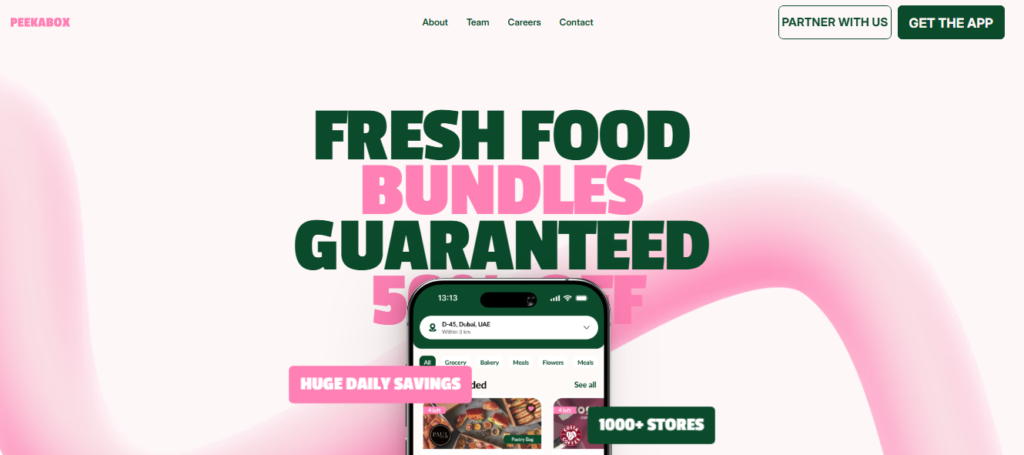
Peekabox is a food-tech platform that connects restaurants, cafes, bakeries, and grocery stores with customers to sell surplus food at discounted prices. The company focuses on reducing daily food waste while making meals more affordable. It operates through a mobile app where users can discover nearby food deals and reserve them easily.
Founding story and current status
Peekabox was built to solve a clear gap in the UAE. Large amounts of fresh food were being thrown away every day, while many people were struggling with rising food costs. The founders saw an opportunity to connect these two sides through a simple platform.
Today, Peekabox has grown into one of the leading food surplus platforms in the UAE. It works with over 1,000 partner stores across 50+ brands. The platform continues to expand its network and aims to scale across the MENA region and Asia.
What problem does it solve?
Peekabox solves two major problems at once. First, it helps businesses reduce food waste by selling unsold items instead of discarding them. Second, it gives customers access to quality food at much lower prices.
In the UAE, a large percentage of prepared food is wasted daily. At the same time, the cost of living is increasing. Peekabox creates a system where businesses recover value and customers save money. This makes the model efficient for both sides.
Evolution of the product and service
Peekabox started with a simple idea of selling surplus food through discounted bundles. Over time, it introduced the “surprise box” model, in which users buy food without knowing the exact items, but at a guaranteed discount.
The platform also improved its user experience by allowing customers to browse nearby stores, reserve meals, and pick them up at fixed times. As the network grew, Peekabox added more premium brands and grocery partners, making the platform more diverse and valuable for users.
How big is the UAE food-tech market, and where does Peekabox fit within it?
Market size
The UAE food-tech market is already a multi-billion-dollar opportunity and growing fast. In 2023, the market reached USD 4.7 billion and is expected to nearly double to USD 8.9 billion by 2030, growing at a steady 9.4% annually.
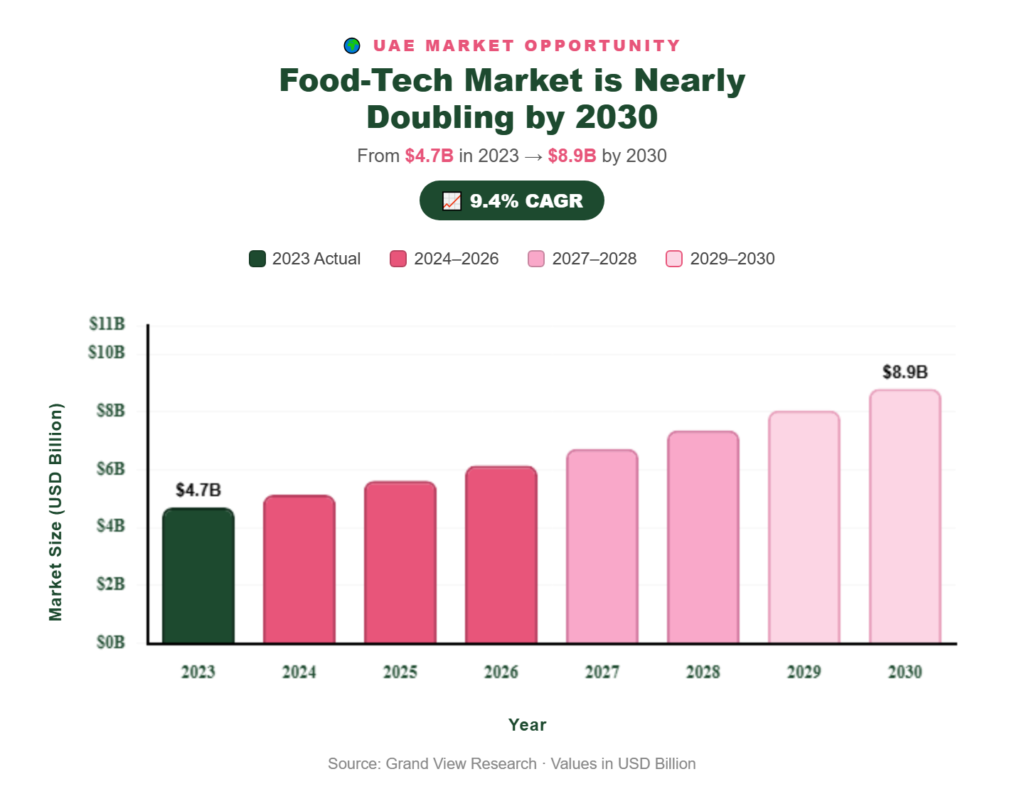
This rapid growth shows how quickly food consumption is moving to digital platforms. Apps, marketplaces, and tech-driven food systems are becoming the default choice for users.
For Peekabox, this creates a strong advantage. It does not need to build demand from scratch. Instead, it plugs into an already-growing food-tech ecosystem and captures a new layer within it, i.e., surplus-food resale.
Growth trends
The UAE food market is growing steadily, with the food products sector expected to reach USD 19.81 billion by 2031, expanding at a 3.96% CAGR from 2026 to 2031.
Clear structural trends drive this growth. The expatriate population accounts for 88.5% of the total population, increasing demand for diverse food options across cuisines. At the same time, urban consumers are eating out more often, with Dubai residents eating out about 3 times per week.
Tourism also plays a key role, with visitor spending expected to reach AED 228.5 billion, increasing demand across restaurants and retail channels.
For Peekabox, these trends directly increase both supply and demand. More consumption leads to more surplus food, while digital and convenience-driven behavior makes it easier for users to adopt platforms like Peekabox.
Peekabox positioning and target audience
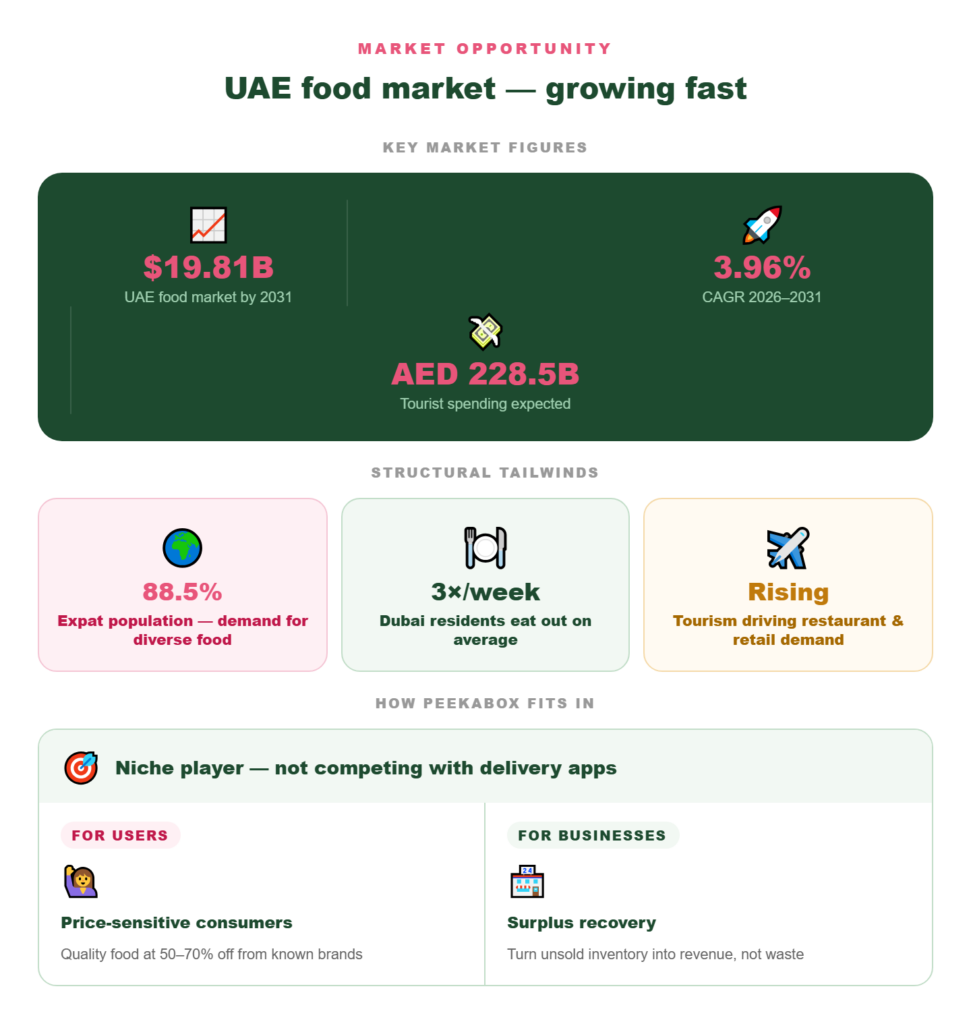
Peekabox positions itself as a niche player within the food-tech market. It does not compete directly with delivery platforms. Instead, it focuses on surplus food from restaurants, cafes, and grocery stores.
Its target audience includes price-sensitive users seeking quality food at lower prices, as well as businesses seeking to recover value from unsold inventory. This clear positioning helps Peekabox stand out within a crowded food-tech space.
Who are the founders of Peekabox?
Hasan Sarwar (CEO & Co-Founder)
Hasan Sarwar is the CEO and co-founder of Peekabox. Before starting the company, he worked in investment banking at Jefferies and studied Philosophy, Politics, and Economics at the University of Warwick.
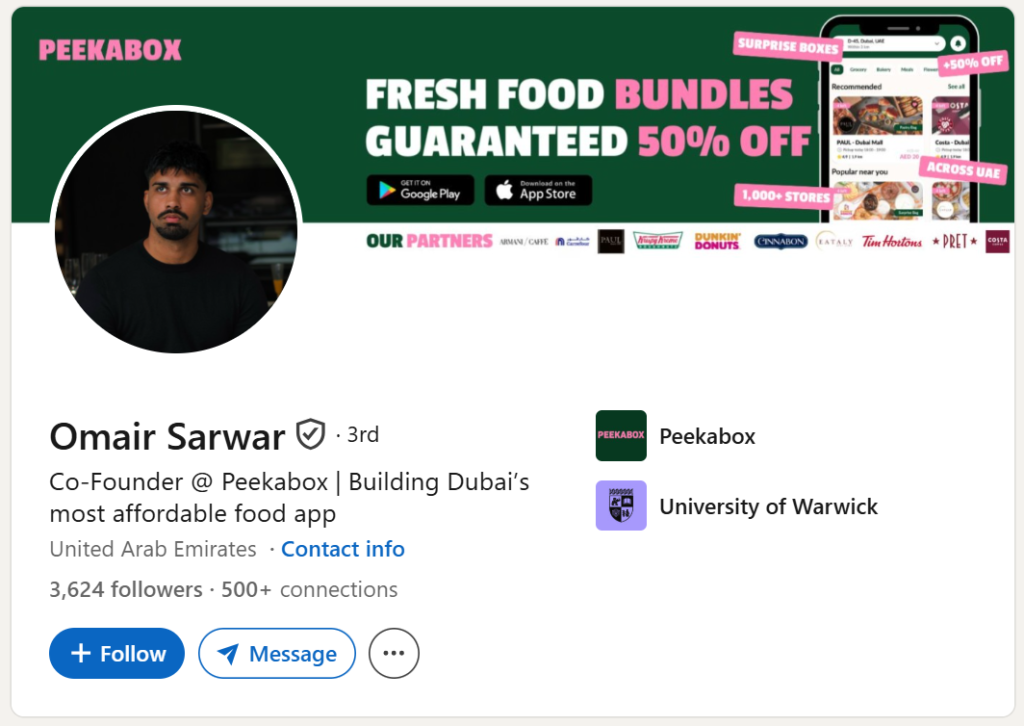
Growing up in Dubai for over 18 years, he observed a recurring problem where large amounts of fresh food were discarded daily. This insight led him to leave banking and build Peekabox. Under his leadership, the platform has signed 1,000+ stores across 50+ brands and raised a $1.5 million seed round backed by leading regional investors.
Omair Sarwar (COO & Co-Founder)
Omair Sarwar is the co-founder of Peekabox and plays a key role in building its operations and supply network. Before starting Peekabox, he worked in investment banking and advisory roles, including real estate private equity and restructuring deals worth over $1 billion.
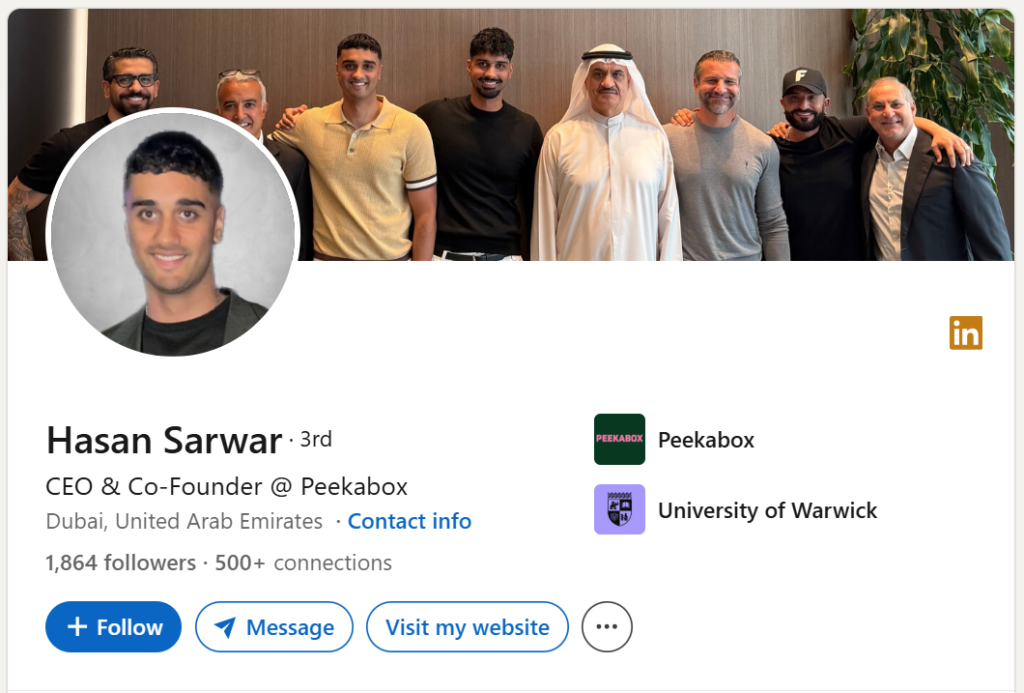
He studied at the University of Warwick. Omair co-founded Peekabox with his brother after identifying a major issue in Dubai, where around 224 kg of food is wasted per person each year. He focused on solving this through infrastructure rather than awareness.
In the early days, he went door-to-door across Dubai to onboard major brands such as Carrefour, Tim Hortons, and Krispy Kreme, helping build the platform’s initial supply base.
Advisory board and leadership team
A strong advisory board with leaders from major global and regional organizations supports Peekabox. This includes Dr. Sameer Al Ansari (Chairman), Fares Akkad, and Yasser Abdulmalak. Their role is to guide strategic decisions, partnerships, and market expansion. The presence of experienced leaders from technology, investment, and food industries adds credibility and helps the company navigate growth in a competitive market.
How did Peekabox turn food waste into a business opportunity?
The idea and early insight
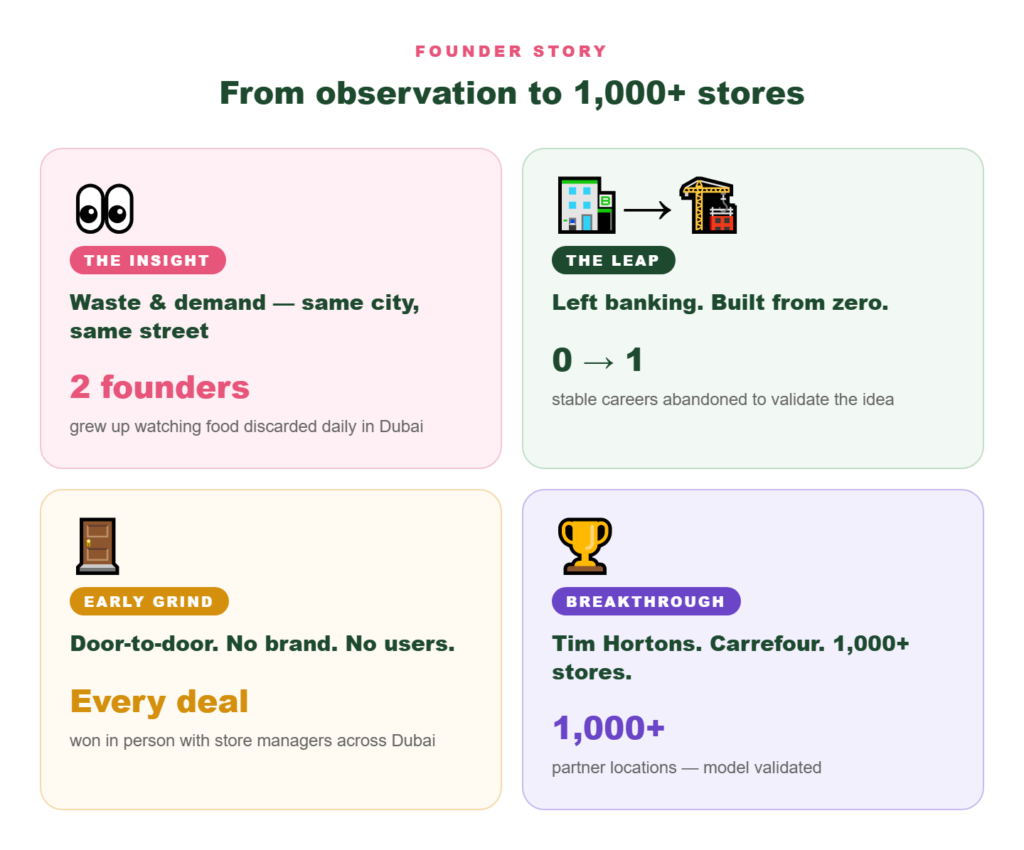
Peekabox started from a simple but clear observation. Both founders grew up in Dubai and saw large amounts of fresh food being thrown away every day. At the same time, food in the city was becoming expensive for many people.
This gap between waste and demand led to the core idea. Instead of treating food waste as a sustainability issue, they saw it as a distribution problem that could be solved with a marketplace.
Leaving stable careers to build Peekabox
Both founders left careers in investment banking to start Peekabox. They moved away from stable jobs to build something from scratch. The goal was to create a system in which surplus food could be sold rather than wasted. This decision marked the real beginning of the company, where they focused fully on building the product and validating the idea in the market.
Early challenges and ground execution
In the early stage, there was no brand, no supply, and no user base. The founders went door-to-door across Dubai and spoke directly with store managers to onboard partners. Convincing large food brands to trust a new platform was difficult. They had to prove that the model would work and create value. Building both supply and demand simultaneously was the biggest challenge.
Early traction and growth signals
The early breakthrough came when well-known brands started joining the platform. Partnerships with companies like Tim Hortons and Carrefour helped build credibility. As more stores joined, the platform reached over 1,000 partner locations. This demonstrated strong demand from both businesses and consumers, quickly validating the model.
What is the meaning behind Peekabox’s name, tagline, and logo?
Meaning behind the name “Peekabox.”
The name “Peekabox” reflects the idea of discovery and surprise. Users do not know exactly what is inside the box, but they know they will get quality food at a lower price. The word “peek” suggests curiosity, while “box” represents bundled food items. Together, the name communicates a simple and engaging concept.
Tagline and brand message
Peekabox focuses on a clear message rather than complex branding. Its core messaging centers on saving food, saving money, and reducing waste. The platform highlights guaranteed discounts and daily savings. The messaging is direct and practical, which makes it easy for users to understand the value.
Logo and brand identity
The logo follows a simple and functional design approach. It aligns with the platform’s focus on usability rather than heavy branding. The identity supports trust and clarity, which are important when users are buying food without knowing the exact items. The brand remains consistent with its core idea of simplicity and value.
How does Peekabox make money? (Business Model and Revenue Streams)
Two-sided marketplace model
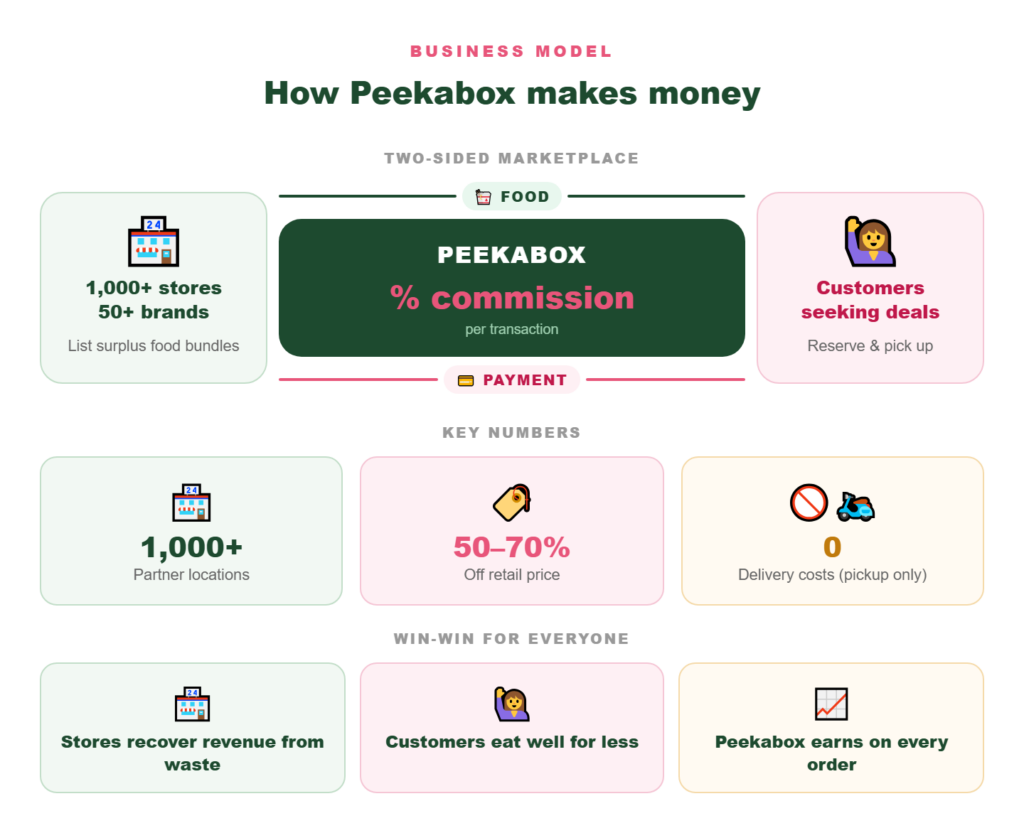
Peekabox operates as a two-sided marketplace that connects food businesses with consumers. On one side, it works with cafes, restaurants, and grocery stores that have unsold food. On the other side, it serves customers looking for affordable meals. This model allows the platform to generate value from both supply and demand without owning inventory.
Commission on each order
The core revenue stream comes from transactions. When a customer buys a surplus food bundle through the app, Peekabox takes a commission from the order. Since all purchases happen inside the platform, every successful transaction contributes directly to revenue.
Partner store network
Peekabox has built a network of 1,000+ stores across 50+ brands. These partners continuously list surplus food on the platform. This creates a steady supply of inventory, which drives repeat usage and consistent transaction volume across the app.
Discounted bundle system (Surprise boxes)
The platform uses a “surprise box” model in which food is sold at 50%–70% off. This pricing strategy increases demand and ensures the fast movement of surplus inventory. Higher-order frequency leads to more transactions, which directly increase platform earnings.
Pickup-based fulfilment model
Peekabox uses a pickup model rather than delivery. Customers reserve food through the app and collect it from the store. This reduces logistics costs and allows the platform to operate with higher margins than traditional delivery apps.
Win-win value system
The business model works because it aligns incentives. Businesses recover value from food that would otherwise be wasted. Customers get quality food at lower prices. Peekabox earns from enabling these transactions at scale, making the model efficient and sustainable.
How fast is Peekabox growing, and what are its key metrics?
User and partner base
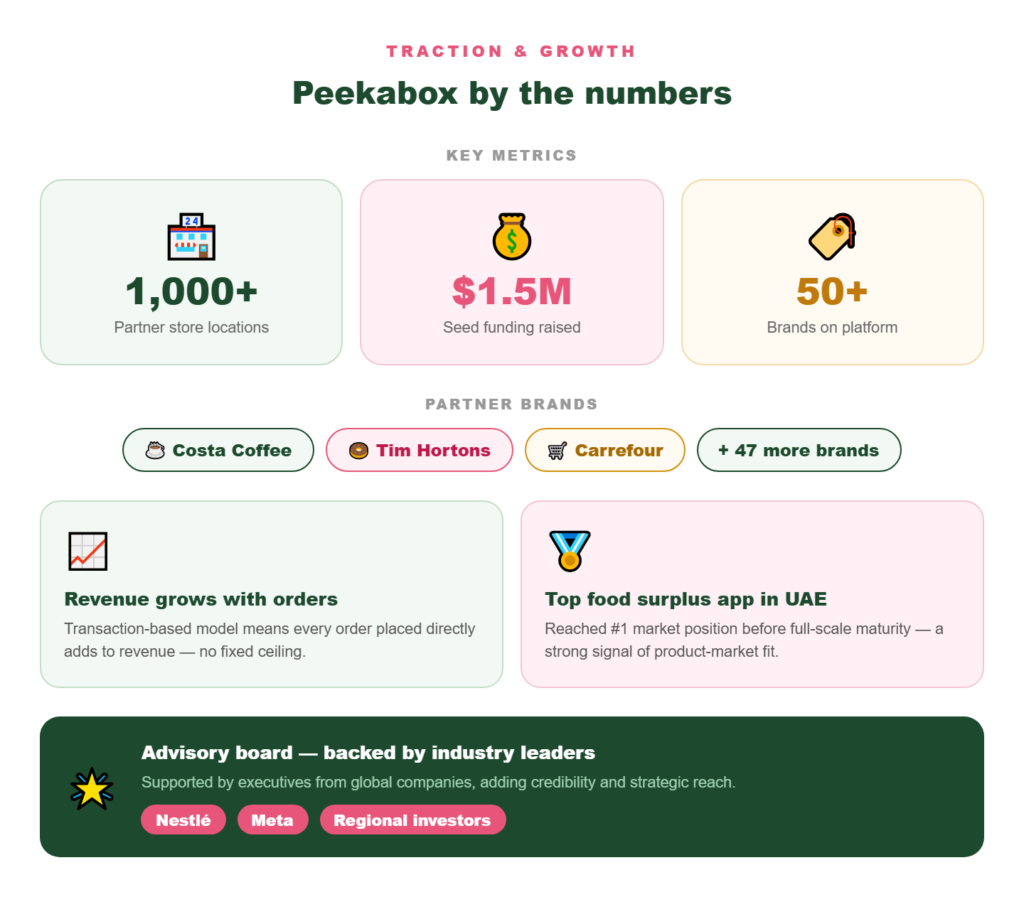
Peekabox has scaled quickly by building a strong supply network. The platform has onboarded 1,000+ stores across 50+ brands in the UAE. These include major names like Carrefour, Costa Coffee, and Tim Hortons.
This wide partner base ensures consistent availability of surplus food and drives repeat usage from customers. While exact user numbers are not publicly disclosed, the scale of store partnerships indicates strong early adoption.
Revenue and funding
Peekabox has raised a $1.5 million seed round, backed by prominent business leaders in the region. This funding supports product development, partner expansion, and market growth. The company has not publicly disclosed its revenue figures yet.
However, its transaction-based model means revenue grows directly with the number of orders placed on the platform.
Key growth indicators
Several early signals show strong traction. The platform has positioned itself as a leading food surplus marketplace in the UAE within a short time. It has successfully partnered with large franchise groups and premium brands, thereby building trust and visibility. The rapid expansion to 1,000+ stores before full-scale maturity shows strong product-market fit.
Market position and achievements
Peekabox is already considered one of the top food surplus platforms in the UAE. Its ability to onboard major brands and to build an advisory board with leaders from companies such as Nestlé and Meta adds credibility. The company’s launch and media coverage, including features in regional publications, further strengthen its position in the food-tech ecosystem.
Which brands are working with Peekabox and why it matters
Partnership with Tim Hortons
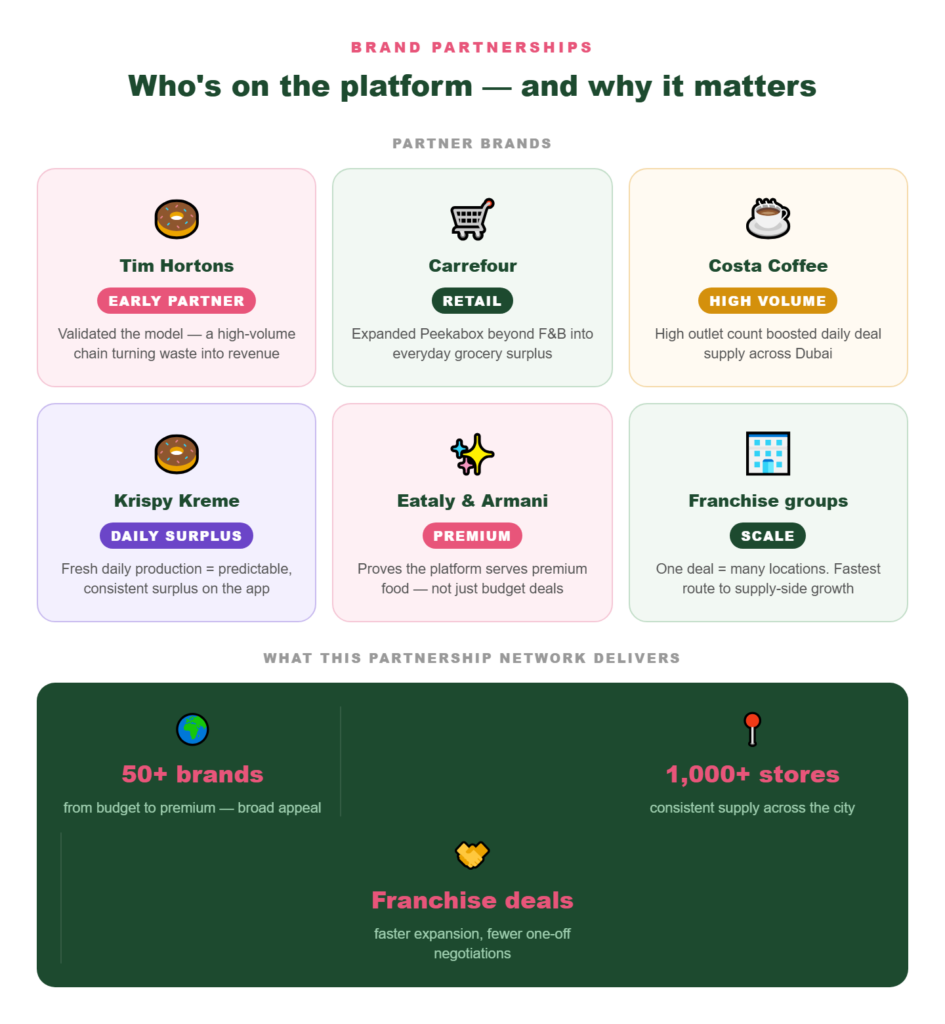
Tim Hortons was one of the early partners to work with Peekabox. This partnership helped validate the model at scale when a high-volume food chain began listing surplus food on the platform. It showed that large brands see value in turning unsold inventory into revenue instead of waste.
Collaboration with Carrefour
Peekabox partnered with Carrefour to bring surplus grocery items onto the platform. This expanded Peekabox beyond restaurants into retail. It also increased the variety of available products, making the platform more useful for everyday users.
Tie-up with Costa Coffee
Costa Coffee joined Peekabox to manage surplus food across its outlets. Since Costa operates at high volume across Dubai, this partnership significantly increased supply on the platform and improved the availability of daily deals for users.
Alliance with Krispy Kreme
Krispy Kreme partnered with Peekabox to sell unsold products, such as doughnuts and baked goods, at discounted prices. This collaboration highlights how the platform works well for brands with daily fresh production and predictable surplus.
Partnership with Eataly and premium brands
Peekabox has also partnered with premium food brands like Eataly and Armani. These partnerships show that the platform is not limited to budget offerings. It also includes high-quality food that would otherwise go to waste.
Collaboration with major franchise groups
Peekabox works with large franchise operators that manage multiple global brands in the UAE. These partnerships help scale quickly across locations and ensure a consistent supply. Instead of onboarding stores one by one, franchise-level agreements allow faster expansion and stronger market presence.
What does Peekabox offer to users and businesses?
Surprise food boxes (core product)
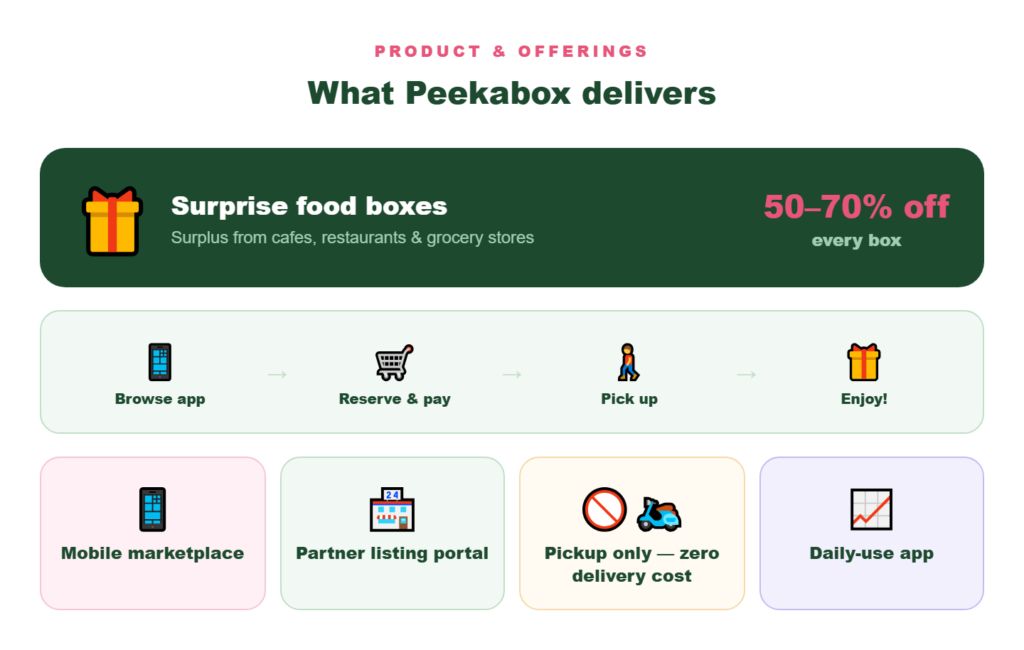
Peekabox’s main offering is “surprise boxes,” which contain surplus food from restaurants, cafes, and grocery stores. Customers buy these boxes at 50% to 70% off without knowing exactly what’s inside. This model helps businesses clear unsold inventory quickly while maintaining value.
For users, it creates a strong price advantage. The concept is simple but effective; it reduces decision-making friction for businesses and increases demand through discounted pricing.
Mobile app marketplace
Peekabox operates through a mobile app where users can browse nearby offers, reserve food, and complete payments. The app acts as the central platform connecting supply and demand. It is designed for quick discovery, allowing users to find deals from known brands in their area. This app-first approach makes the platform scalable and easy to use, especially for urban consumers who rely on mobile-based food services.
Partner platform for businesses
Peekabox provides a system for partner stores to quickly list surplus food. Businesses can upload available items in seconds and convert waste into revenue. This service reduces operational complexity for store managers who would otherwise discard unsold food.
The platform serves as a structured decision layer, helping businesses manage surplus more efficiently rather than relying on manual discounting or disposal.
Pickup and reservation system
The platform follows a pickup-based model. Customers reserve their food through the app and collect it at a fixed time from the store. This ensures smooth coordination between supply and demand. It also eliminates delivery costs, which helps keep prices low. The pickup system is critical to maintaining margins while ensuring that food is collected within a safe time window.
Product evolution and expansion
Peekabox started with a basic surplus-listing concept and evolved into a structured marketplace featuring brand partnerships and large-scale store onboarding. It expanded from small outlets to major franchise groups and premium brands.
The focus has been on improving supply consistency, user experience, and partner onboarding speed. Over time, the platform has strengthened its positioning as a daily-use app for affordable food.
What problems did Peekabox face while scaling?
Building supply from scratch
In the early stage, Peekabox had no partner network. The founders had to approach stores directly and convince them to trust a new platform. This required strong execution and persistence.
Changing customer behavior
Customers are used to choosing exact food items. The “surprise box” model required users to accept uncertainty. Educating users about value over choice was a key challenge.
Supply inconsistency
Surplus food changes daily based on demand. This makes inventory unpredictable. Maintaining a consistent user experience with variable supply is difficult.
Competition from traditional platforms
Food delivery apps already dominate the market. Peekabox had to position itself differently rather than compete directly on convenience.
Operational scaling
Managing 1,000+ stores requires strong coordination. Ensuring timely pickup, accurate listings, and smooth operations across locations is complex.
Market education
The concept of selling surplus food is still new in many regions. Peekabox must continuously educate both businesses and users about its value.
Who are Peekabox’s main competitors, and how do they compare?
Too Good To Go
A global leader in surplus food marketplaces. It operates in multiple countries and has a large user base. Its strength is scale, but it is not locally focused on the UAE.
OLIO
OLIO focuses on peer-to-peer food sharing instead of commercial surplus. It builds community-driven redistribution but lacks strong retail partnerships.
Karma
Karma operates mainly in Europe. It connects restaurants with users to offer discounted surplus food, similar to Peekabox, but with a limited presence in the Middle East.
Traditional food delivery apps
Platforms like Talabat and Deliveroo focus on convenience and full-price orders. They do not specialize in surplus food, which gives Peekabox a niche advantage.
Competitor comparison table
| Company | Focus | Strength |
| Peekabox | Surplus food marketplace | Local partnerships, discount model |
| Too Good To Go | Global surplus platform | Large scale and user base |
| OLIO | Food sharing | Community driven |
| Karma | Surplus food | European presence |
| Talabat | Food delivery | Convenience and scale |
| Deliveroo | Food delivery | Fast logistics |
What is next for Peekabox? Growth, expansion, and roadmap
Regional expansion
Peekabox plans to expand beyond the UAE into the broader MENA region and parts of Asia. This will increase its market size and partner network.
Increasing partner network
The company aims to onboard more restaurants, cafes, and grocery stores. Expanding supply will improve consistency and user experience.
Product and platform improvements
Future updates will likely focus on improving app usability, discovery, and personalization. This will help increase repeat usage and retention.
Category expansion
Peekabox may expand beyond food into other surplus categories. This can include retail products with limited shelf life.
Long-term growth outlook
As the platform scales, it may explore larger funding rounds or strategic partnerships. While no IPO plans are public yet, the growth trajectory supports long-term expansion opportunities.
FAQs
When did Peekabox start?
Peekabox began operations in the mid-2020s, with its official launch in the UAE announced for May 2026. The company spent its early phase building partnerships, onboarding stores, and preparing the platform before going live to consumers at scale.
How does Peekabox make money?
Peekabox makes money through a commission-based model. It takes a percentage from every transaction when users purchase surplus food through the app. The platform earns more as order volume increases across its partner network.
What is Peekabox?
Peekabox is a food-tech marketplace that helps restaurants, cafes, and grocery stores sell surplus food at 50% to 70% discounts. Customers can browse, reserve, and collect these meals through the app, reducing food waste and saving money.
When was Peekabox founded?
Peekabox was founded in the mid-2020s by Hasan Sarwar and Omair Sarwar. The idea was developed after observing large-scale food waste in Dubai and identifying a gap between unused food supply and consumer demand.
Which brands are partnered with Peekabox?
Peekabox partners with over 1,000 stores across 50+ brands, including Carrefour, Costa Coffee, and Tim Hortons. These partnerships help ensure a steady supply of surplus food on the platform.
How does Peekabox reduce food waste?
Peekabox reduces food waste by connecting businesses that have unsold food with customers willing to buy it at a discount. Instead of discarding food at the end of the day, stores list it on the app, allowing it to be consumed rather than wasted.