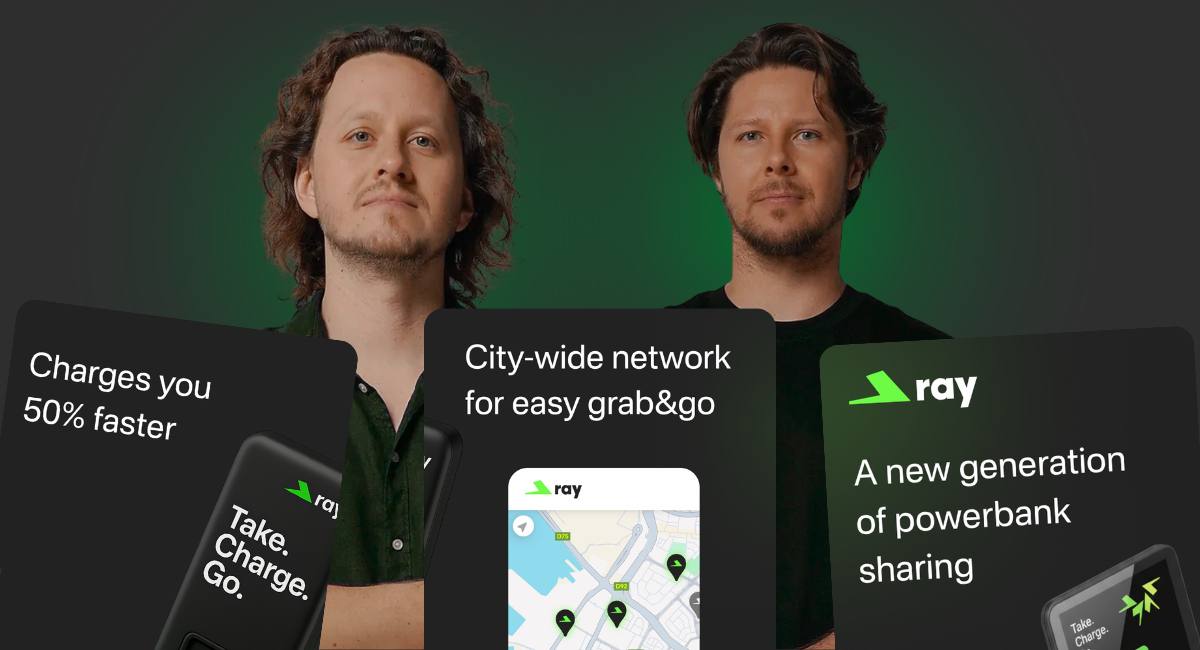
UAE-based startup Ray has stepped into the shared infrastructure space with a clear focus on solving a daily problem.
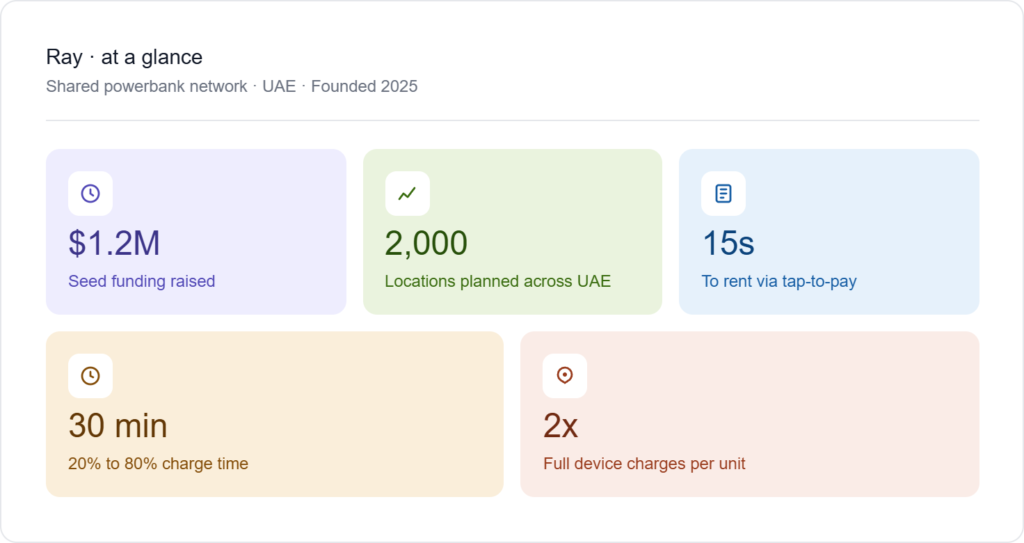
The company raised $1.2 million in seed funding and has already rolled out its service in Dubai and Abu Dhabi.
Instead of building just another utility, Ray is trying to become a default layer in how people stay connected when their phone battery runs low.
How does Ray turn everyday battery anxiety into an on-demand service?
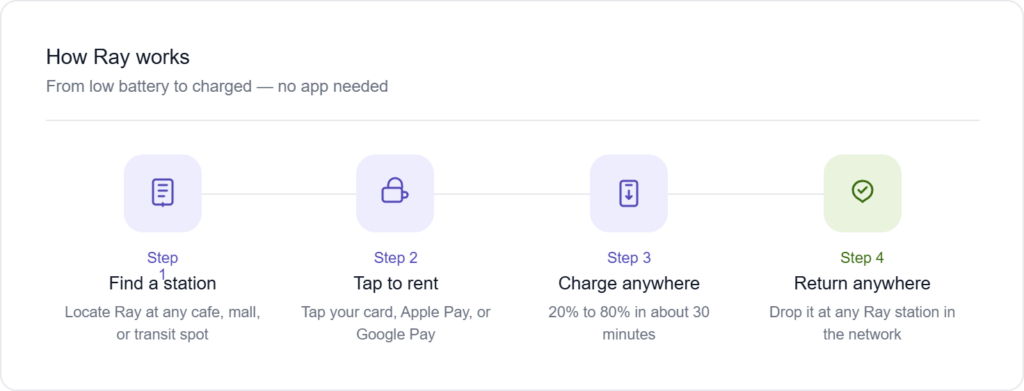
Ray’s core product is simple, but its use case is strong. The company installs portable charging stations across public places where people naturally spend time. These include cafes, restaurants, malls, and transit areas.
A user can pick up a powerbank from one station and return it at any other station in the network. This removes the need to carry chargers or search for sockets.
The value becomes clear in real moments. When someone is navigating, making payments, or waiting for a ride, a dead phone creates friction. Ray positions itself as the fastest way to remove that friction without changing user behavior.
Who are the founders and what problem are they solving differently?
Ray was founded in 2025 by Igor Kosolap and Roman Averianov. Instead of starting with features, the founders focused on context. They looked at when and why users need charging the most. The answer was clear. People need it urgently, often when their phone is already low.
This insight shaped the product. Every step is designed to reduce delay. The system works even when the user cannot rely on their phone, which is a key difference from app-heavy services.
Who invested in Ray and why does it matter for growth?
The $1.2 million seed round includes investors like Meirambek Abelkasov and Serik Uspanov from JET.
These investors have experience in building shared mobility networks, where success depends on placement, usage density, and operational efficiency.
Their backing adds more than capital. It brings insight into scaling physical networks in urban environments, which is critical for a business like Ray.
Early Launch in Dubai and Abu Dhabi With Aggressive Rollout Plans
Ray has already launched in Dubai and Abu Dhabi.
The company plans to expand to 2,000 locations across the UAE within a short timeframe. This is not just about growth. It is about building network density.
In shared systems, availability drives usage. The more stations users see around them, the more likely they are to depend on the service. Ray is focusing on this density early to build a habit.
Tap-to-Pay System Changes How Users Access Charging Services
One of Ray’s strongest features is its Tap-to-Pay technology.
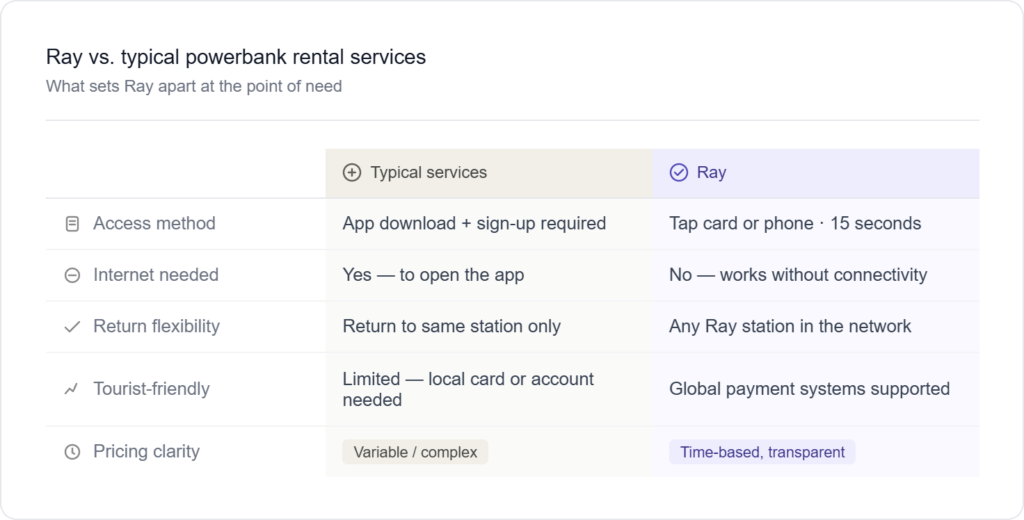
Users can rent a powerbank by tapping a bank card or using Apple Pay or Google Pay. The process takes about 15 seconds and does not require an app or internet connection.
This is important in real-world scenarios. When a phone battery is critically low, users do not want to download apps or complete long sign-up steps.
Ray removes that entire layer. The experience feels closer to a quick transaction than a service onboarding flow.
Growing Dependence on Smartphones Creates a Strong Usage Base
Smartphones are now central to how people manage daily life. They are used for payments, communication, travel, and even identity verification.
At the same time, battery performance still limits usage. Many users experience stress when their battery drops below a certain level, and a large percentage run out of charge before the day ends.
Ray fits directly into this gap. It does not try to change behavior. It supports existing habits by making power access available wherever needed.
What makes the UAE an ideal market for this model?
The UAE presents a strong environment for this model.
Cities like Dubai attract millions of visitors every year and have a large base of residents who rely heavily on digital services. The number of hospitality venues and public spaces creates multiple touchpoints for charging stations.
This leads to repeated usage cycles. A user might pick up a powerbank at a cafe, use it while commuting, and return it at a mall.
Such patterns increase both usage frequency and revenue potential per device.
Technology Stack Built for Stability and Cross-Border Scaling
Ray’s infrastructure is not limited to physical stations. It is supported by a strong backend system.
The company has integrated global payment systems, allowing users from different countries to access the service without friction. This is essential in a market with high tourist inflow.
It also uses IoT connectivity to manage stations in real time. This includes tracking device availability, monitoring performance, and ensuring uptime.
This combination allows Ray to scale across cities and countries without rebuilding its core system.
Charging Performance Designed for Speed and Practical Use
The power banks are optimized for quick charging sessions. They can charge a smartphone from 20 percent to 80 percent in around 30 minutes. Each unit has enough capacity to recharge a device up to two times.
This makes the service useful for short breaks as well as longer periods. Users do not need to plan their charging. They can use it as needed and return it when convenient.
Revenue Model Built Around Usage Simplicity and Repeat Behavior
Ray follows a time-based rental model. Here’s how it works:
Users are charged based on how long they use the powerbank. The pricing is straightforward, which reduces confusion and increases trust.
Because the service solves a recurring problem, it naturally drives repeat usage. Users are likely to return whenever they face the same situation again. The Tap-to-Pay system further improves conversion by removing entry barriers.
Competitive Position Strengthened by Frictionless Access
Ray’s main advantage comes from how easy it is to use.
Most similar services depend heavily on apps, which creates friction at the point of need. Ray avoids that by allowing instant access through payment systems people already use. This improves both user experience and operational efficiency. Higher conversion leads to better utilization of each station.
What are Ray’s next steps for expansion across the GCC?
After building a strong base in the UAE, Ray plans to expand across the GCC.
The company is targeting markets with similar urban density and digital adoption patterns. Its infrastructure is already designed to support this expansion.
The focus will remain on placing stations in locations where usage is frequent and predictable.
What this means for the future of urban infrastructure in the UAE:
Ray is not just offering a charging solution. It is building a layer that supports how people stay connected in cities.
As smartphones become more central to daily life, services like this move from optional to essential.
With early funding, strong investors, and a clear execution plan, Ray has the potential to scale quickly and become a common utility in urban environments across the region.