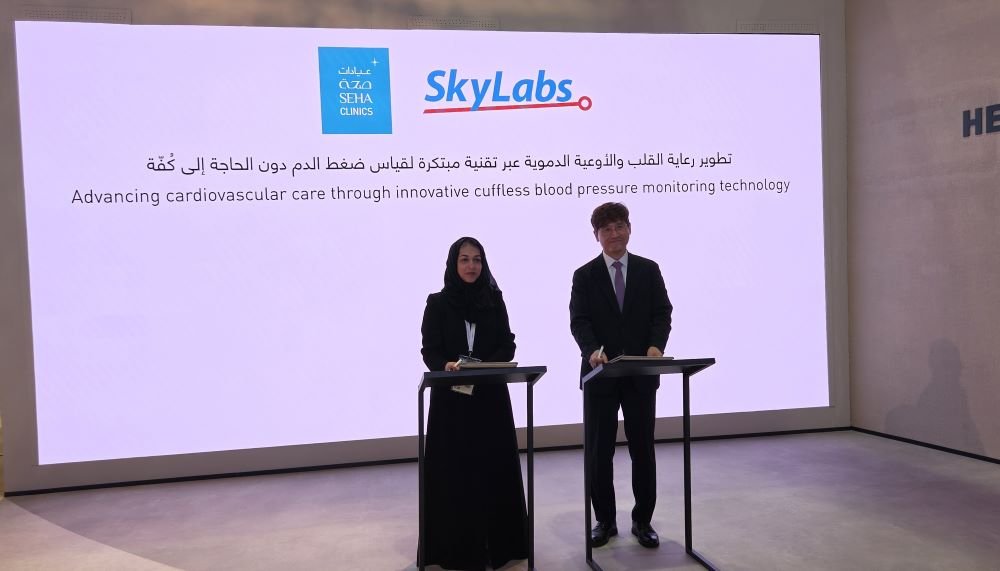
A ring that reads blood pressure without a cuff is on its way to Abu Dhabi’s clinics. Korean healthtech company Sky Labs has signed an agreement with SEHA Clinics to test its CART BP ring in clinical settings across the emirate. The deal was signed on the sidelines of the Abu Dhabi Future Health Summit, held from 20 to 22 October, and announced on Monday.
A ring instead of a cuff
The CART BP ring is worn on the finger and measures blood pressure through the day and night, without the repeated squeezing of an arm cuff. It uses light sensors and AI to read blood flow and turn it into pressure readings. Sky Labs says the device can collect data during daily activities and sleep, which gives doctors a fuller picture than a single reading in a clinic.
The technology is not new to Sky Labs. The company was founded in South Korea in September 2015 and built its business around CART, a ring type medical device for monitoring chronic disease. Its clinical version, CART BP pro, received medical device approval in 2023 and is prescribed in hospitals and clinics in Korea, where it is covered by health insurance for round the clock monitoring.
A consumer version, CART BP, went on sale in Korea in September 2025 at 550,000 won, about $392, without the need for a hospital prescription. The Abu Dhabi pilot will use the clinical version of the device, and it is the company’s first step into the Middle East’s healthcare system.
Why Abu Dhabi’s clinics are the right test
SEHA Clinics runs Abu Dhabi’s largest primary care network, recording about 4.1 million outpatient visits in 2025, up 14.5% on the year before. The network has been expanding its facilities, including chronic disease management and preventive care. For Sky Labs, that scale is the point. A pilot across a network of that size can show whether a ring can hold up in everyday clinical practice, not just in a trial.
SEHA Clinics is part of PureHealth, one of the Middle East’s largest integrated healthcare groups, with annual revenue of about $7.37 billion in 2025. Its network spans hospitals, outpatient facilities and health insurance providers. Sky Labs also plans to explore wider cooperation with hospitals under PureHealth and with Daman, a major UAE health insurer.
The need is large, and the deal is only a first step
High blood pressure is common in the region. The World Health Organization puts hypertension prevalence in the Eastern Mediterranean region, which includes the Middle East, at 38%, against a global average of 33%. In the UAE, an estimated 1.8 million of about 2.1 million people with hypertension do not have their blood pressure adequately controlled. A device that measures it through the day could help close that gap.
It is worth keeping the deal in perspective. The agreement is an initial step towards possible commercial supply, not a confirmed supply contract. Sky Labs will first assess the clinical usability of its monitor at SEHA Clinics, and explore commercial supply based on the results. For now, the ring is being tested, not sold.
“It is very meaningful to cooperate with SEHA Clinics, which is responsible for the daily medical care and health management of Abu Dhabi residents,” said Sky Labs chief executive Lee Byung-hwan. “We will demonstrate the technology’s value in clinical practice through the pilot and pursue opportunities for commercial supply in the Middle East,” he added.
What a ring on a finger means for Abu Dhabi’s clinics
Here is what matters about this deal. The ring itself is not the story. The story is what happens when blood pressure stops being a number taken once in a clinic and becomes a stream of data from everyday life. That shift suits Abu Dhabi, which has spent years building prevention into its health system. But it also raises a harder question. Data is only useful if clinics act on it, and a ring that flags a problem at 3am is only as good as the system that answers. The pilot will show whether Abu Dhabi can close that loop.