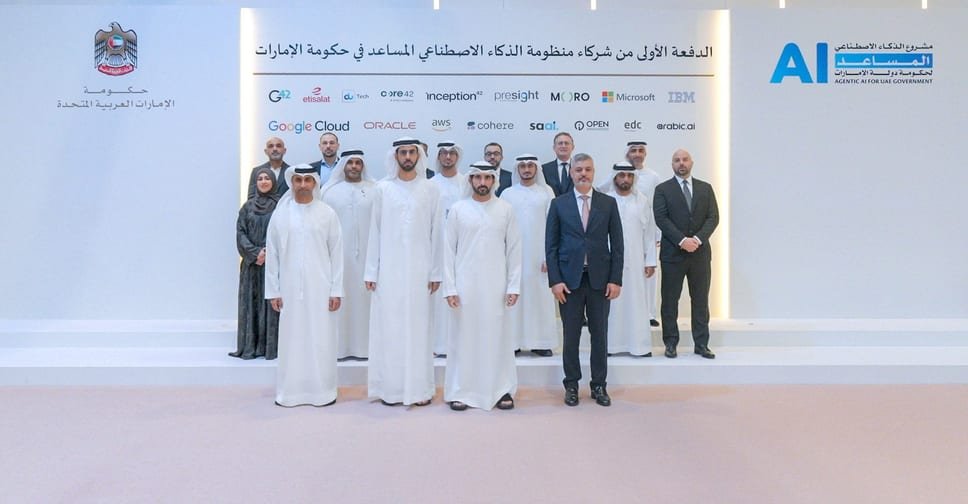
The UAE’s plan to put AI to work inside government took its biggest step yet on 27 November. Seventeen national and international partners joined FedAI, the country’s National Integrated Agentic AI Ecosystem, in an announcement witnessed by Sheikh Hamdan bin Mohammed bin Rashid Al Maktoum.
FedAI is the shared platform the UAE will use to run agentic AI across federal government. Instead of each department buying its own tools, government entities will draw on one secure national system with access to leading AI models, platforms and solutions.
The goal is ambitious. Within two years, the UAE wants half of all government sectors, services and processes running on agentic AI operating models. The partners announced today are the first group to join, and more are expected to follow.
Who the 17 partners are
The list mixes UAE capability with global scale. From the Emirates come G42, Inception42, Presight, Core42, Etisalat, du and Moro Hub. From abroad come Microsoft, AWS, Google Cloud, Oracle, IBM, Cohere, SAAL, Open Innovation, Arabic.AI and EDC.
G42 leads the UAE contingent, with Inception42, Presight and Core42 beside it, and Etisalat, du and Moro Hub covering connectivity and data centres. The global names bring the cloud platforms, models and enterprise software that government departments already use, now inside a sovereign government framework.
Sheikh Hamdan said the system brings together national capabilities and global expertise. The point, he said, is to move from testing AI applications to using them in daily government work.
How FedAI changes daily government work
Agentic AI is different from the chatbots most people know. Instead of only answering questions or generating text, agentic systems can carry out tasks on their own, analyse information, manage processes and coordinate several actions at once.
FedAI gives departments one governed way to use that capability. It offers sovereign hosting for open models, organised access to approved suppliers and a single AI portal where entities can find solutions, use cases and integration requirements.
The system is designed to cut costs and speed up delivery. Departments will be able to share technological solutions with each other, avoid buying the same tools twice, and move faster from a pilot project to a service people actually use.
The announcement comes two days after the UAE Cabinet approved a comprehensive government strategy for agentic AI and formally endorsed FedAI. Sheikh Mohammed bin Rashid first set the two year transformation target in April 2026, describing AI as an executive partner in government operations.
80,000 federal employees to be trained in AI
The partner announcement came with a second one: nine technology companies will help train federal government employees in agentic AI. The companies are Etisalat, Inception42, Presight, ai71, Microsoft, Google Cloud, Oracle, Amazon Web Services and Accenture.
The training is part of the largest programme of its kind in the federal government, aiming to equip more than 80,000 employees with agentic AI skills. It will run through specialist courses, workshops, labs and a digital learning platform powered by agentic AI.
The strategy sets hard targets. It aims to cut the time needed to complete government operations and develop strategies by at least 50 per cent, improve the quality and accuracy of government outputs by 90 per cent, and deploy at least 90 per cent of agentic AI models and systems within secure government infrastructure.
Mohammad Al Gergawi, Minister of Cabinet Affairs, said the partnerships would give federal employees access to industry expertise as they put the leadership’s AI directives into practice. The training push was launched in the presence of Sheikh Mansour bin Zayed Al Nahyan.
What FedAI means for people dealing with government
FedAI will be judged by a simple test: does dealing with the government get faster and easier? The partner list is impressive, but a wall of logos is not a service. The real change comes when a resident can describe a problem in plain language and have it handled, instead of working out which department owns it.
That is where Mira, the government’s new AI assistant, fits in. Announced this week and due to reach users from March 2027, it is the public face of the same plan. FedAI is the engine room, and Mira is the door.
The risk is not the technology but the pace. Training 80,000 people and moving half of government to new operating models in two years is a huge task, and most government AI plans slow down at exactly this point.
If the UAE pulls it off, other governments will study FedAI closely. If it stalls, the partner list will be remembered as the easy part.