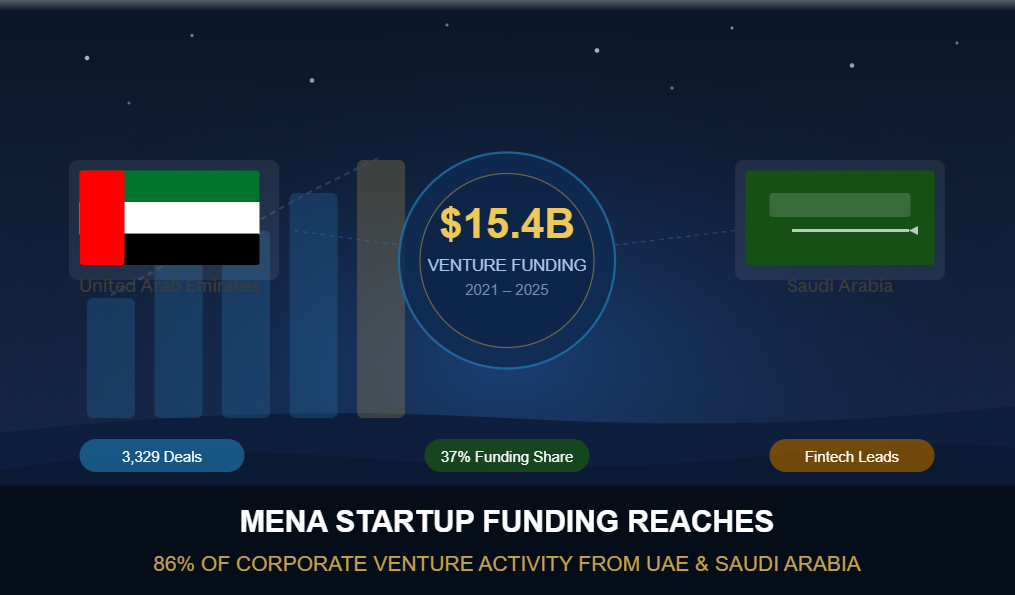

Startup funding in the Middle East and North Africa is slowing down, but the United Arab Emirates continues to lead the market. In Q1 2026, the region raised $941 million, with the UAE contributing the largest share.
In this report, we break down key trends, sectors, and funding patterns.
We also reviewed Wamda’s monthly reports to uncover deeper insights behind the numbers.
Why Did MENA Startup Funding Drop in Q1 2026?
Startup funding in the Middle East and North Africa fell to $941 million in Q1 2026. This marks a 21.5% drop from the previous quarter and a 37% decline year on year.
The main reason is rising geopolitical tension. Conflicts involving the United States, Israel, and Iran reduced investor confidence.
The situation worsened when disruptions hit global trade routes, especially around the Strait of Hormuz. This increased risk across oil, shipping, and supply chains. Investors responded by slowing down deal activity and holding back capital.
How Did the UAE Lead Startup Funding in the Region?
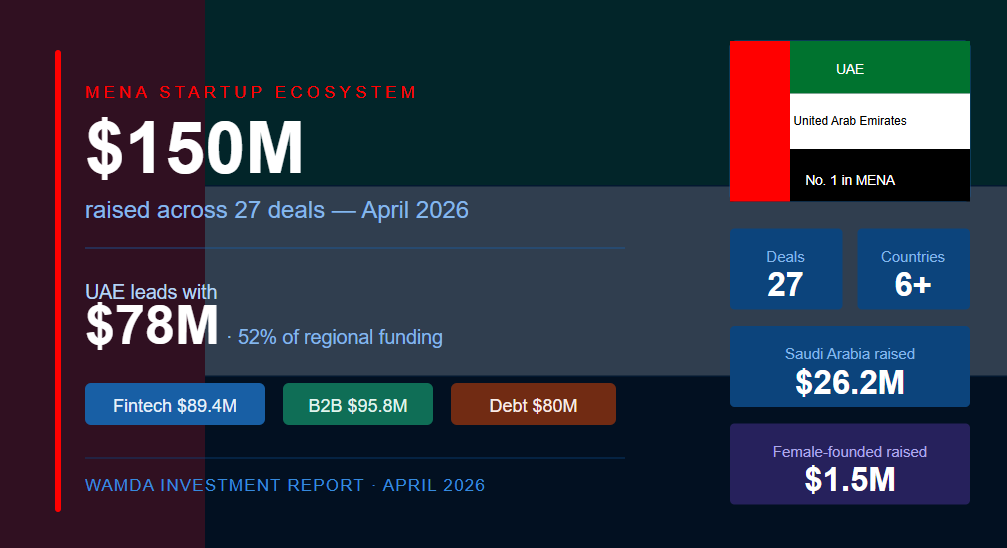
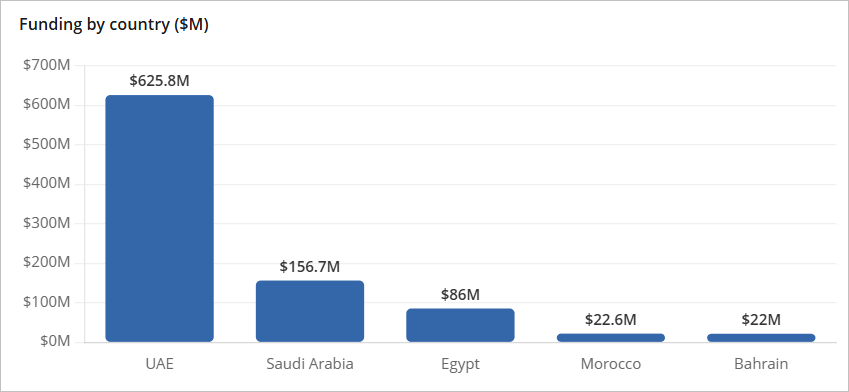
The United Arab Emirates dominated MENA startup funding in Q1 2026. Startups in the UAE raised $625.8 million across 46 deals, which is a large share of the total regional funding. This shows that even during uncertainty, investors still trust the UAE market.
Strong infrastructure, business-friendly policies, and access to global capital continue to make the UAE a preferred destination for startups and investors.
What Happened to Monthly Funding Activity?
The quarter shows a clear shift in momentum:
- January: Nearly $500 million across 59 deals
- February: Dropped to $326.6 million as tensions increased
- March: Sharp decline with only 17 startups raising less than $50 million
This trend shows how quickly investor sentiment changed. The market moved from active funding to a near pause within weeks.
Which Countries Followed After the UAE?
Other MENA countries saw funding, but at much lower levels:
- Saudi Arabia raised $156.7 million across 57 deals
- Egypt secured $86 million across 12 deals
- Morocco raised $22.6 million
- Bahrain raised $22 million
The gap shows that capital is concentrating in fewer, more stable markets.
Which Sectors and Startup Stages Are Getting the Most Investment?
Investor focus in Q1 2026 shows two clear shifts. First, where the money is going. Second, how it is being deployed across stages.
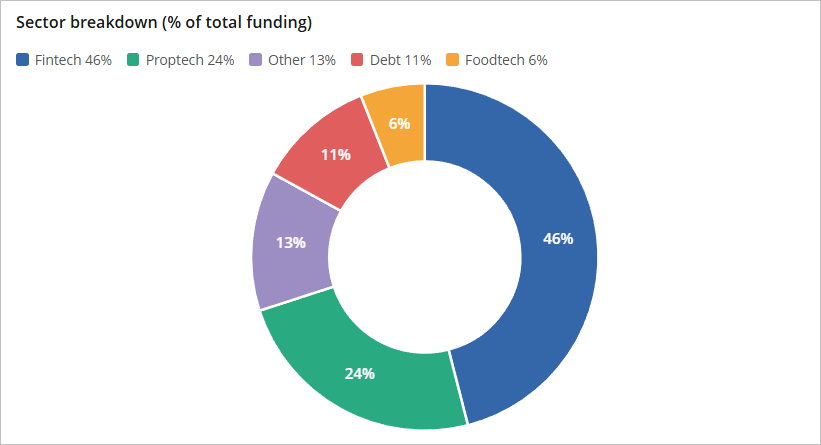
Fintech led the market, accounting for 46% of total funding. Investors prefer this sector because it offers clear revenue models and strong scalability. Proptech came next with $228.6 million, followed by foodtech with $60 million. These sectors attract capital because they solve real problems and show steady demand.
At the same time, funding patterns changed across startup stages. Early-stage startups remained active, with 110 deals worth $233 million. Investors are still open to backing new ideas and emerging founders.
However, late-stage funding dropped sharply. Only seven deals raised $113 million. Investors are avoiding large investments due to higher risk and market uncertainty.
This shift shows a clear pattern. Capital is still flowing, but it is moving toward safer sectors and smaller, early-stage opportunities.
What Is the Difference Between B2B and B2C Funding Trends?
The funding split between B2B and B2C startups shows how investors are balancing risk and growth.
B2B startups led in deal volume, with 74 deals worth $199 million.
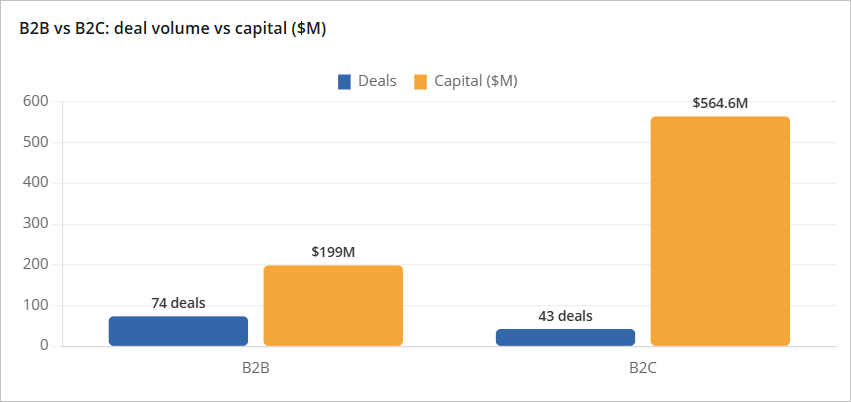
This indicates steady and consistent demand for business-focused solutions such as SaaS, enterprise tools, and infrastructure platforms. These startups often have longer sales cycles but offer predictable revenue and strong client retention, which makes them safer bets in uncertain markets.
In contrast, B2C startups attracted the majority of capital, raising $564.6 million across 43 deals. Investors are willing to place larger bets on consumer platforms because they can scale quickly and capture large user bases. If successful, these startups can generate rapid revenue growth and strong market dominance.
This trend shows a clear strategy. Investors are spreading risk by funding more B2B startups while placing bigger, high-conviction bets on scalable B2C businesses.
Why Is the Gender Funding Gap Still So High?
The funding gap between male-led and women-led startups remains one of the biggest challenges in the ecosystem.
In Q1 2026, only five women-led startups raised funding, securing a combined $500,000. This is extremely low compared to the overall capital available in the market.
On the other hand, male-founded startups raised around $924 million, accounting for 98% of total funding. This shows that access to capital is still heavily skewed.
Several factors contribute to this gap. Women founders often face limited access to investor networks, fewer opportunities for large funding rounds, and bias in decision-making processes. As a result, even strong business ideas may struggle to secure capital at scale.
This imbalance is not just a diversity issue. It also limits innovation, as a large portion of potential founders remain underfunded and underrepresented.
What Does This Mean for UAE Startups?
The UAE remains the strongest startup hub in MENA, but the market is changing.
Funding is still available, but investors are more selective. Startups need to show clear revenue models, strong fundamentals, and low risk.
Early-stage founders may still find opportunities, but late-stage startups could face delays in raising capital.
In short, UAE startups are in a strong position, but they must adapt to a more cautious and competitive funding environment.